
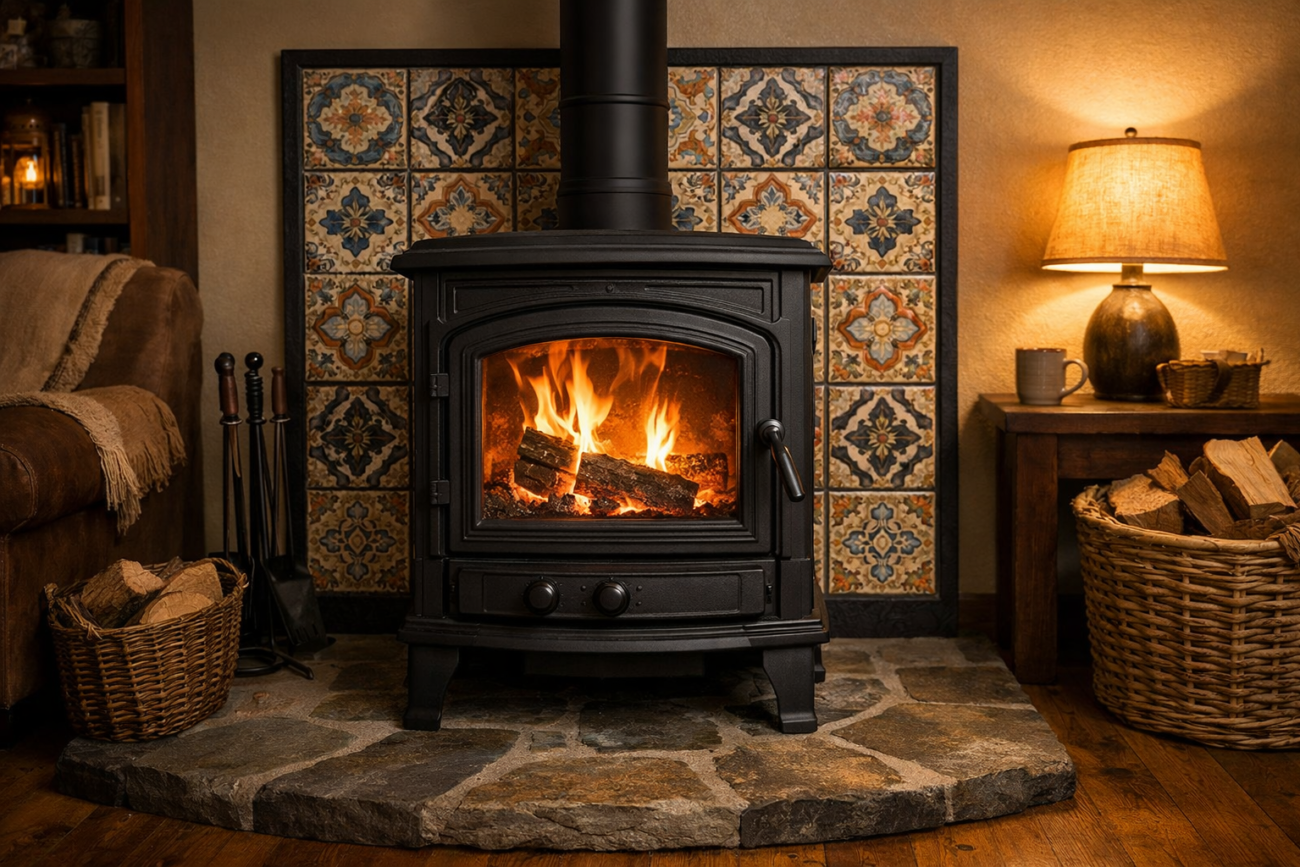
You’ve found the perfect spot for your wood stove, but there’s one problem: the wall behind it is only 18 inches away. Or maybe you’re installing in a corner, or on a combustible floor, and you’re not sure what protection you actually need. A wood stove heat shield is the answer, and understanding when and why you need one could be the difference between a safe, code-compliant installation and a serious fire hazard.
Here’s the short answer: a wood stove heat shield is a non-combustible barrier installed between your stove and nearby combustible surfaces like wood walls, floors, or ceilings. Without a wood stove heat shield, most stoves require 36 inches of clearance from combustible walls. With a properly built wood stove heat shield, that clearance can be legally reduced to as little as 12 inches, giving you far more flexibility in where you place your stove. If your stove is within 36 inches of any combustible surface, you need a wood stove heat shield. Full stop.
I’ve helped dozens of homeowners navigate wood stove installations over the years, and the wood stove heat shield question comes up every single time. People either skip it entirely (dangerous) or overthink it into paralysis (unnecessary). The reality is that a wood stove heat shield is one of the most straightforward safety components in the whole installation, once you understand the basics.
In this guide, you’ll learn exactly when a wood stove heat shield is required, the different types available, what materials actually work, how to build or buy one, and how to stay code-compliant without spending a fortune. Whether you’re doing a new installation or retrofitting an existing setup, this wood stove heat shield guide covers everything you need.
What Is a Wood Stove Heat Shield and Why Does It Matter?
A wood stove heat shield is a non-combustible panel or assembly that protects combustible surfaces from the intense radiant heat produced by a wood stove. Wood stoves can reach surface temperatures of 400-700°F during normal operation. At those temperatures, wood framing, drywall, and paneling within a few feet of the stove can slowly char over time, eventually reaching ignition temperature, even without direct flame contact. That process is called pyrolysis, and it’s the reason clearance requirements exist.
The heat shield works by intercepting radiant heat before it reaches the combustible surface behind it. A properly built heat shield with a ventilated air gap behind it can reduce the heat reaching the wall by 60-70%, which is why it allows you to cut required clearances so dramatically.
According to the National Fire Protection Association’s NFPA 211 standard, which governs solid fuel appliance installations across North America, a wood stove heat shield must be constructed of non-combustible materials, mounted with a minimum 1-inch air gap from the wall using non-combustible spacers, and extend at least 18 inches beyond the sides and top of the stove. These aren’t suggestions, they’re code requirements that your local building inspector will check.
The Consumer Product Safety Commission reports that heating equipment, including wood stoves, is involved in roughly 14% of all home fires annually. A significant portion of those fires involve improper clearances or missing wood stove heat shield protection. This isn’t a technicality, it’s a real safety issue that affects real homes.
If you want to understand the full technical code requirements in detail, our dedicated wood stove heat shield requirements guide covers every NFPA 211 specification. This article focuses on the practical decision-making: when you need one, which type to choose, and how to get it right.


When Do You Actually Need a Wood Stove Heat Shield?
Not every wood stove installation requires a heat shield. But most do. Here’s how to know for certain whether your setup needs one.
The 36-Inch Rule
The baseline clearance for most wood stoves without any wood stove heat shield protection is 36 inches from combustible walls on the sides and rear. If every wall near your stove is more than 36 inches away, you technically don’t need a wood stove heat shield for wall protection. In practice, that’s a lot of space, and most rooms don’t have it.
Measure from the stove’s outer surface (not the center) to the nearest combustible wall. If that distance is less than 36 inches on any side, you need a wood stove heat shield on that wall. Many homeowners are surprised to discover their “plenty of space” installation is actually 24 or 28 inches from the wall, well within the danger zone.
Floor Protection Requirements
A wood stove heat shield isn’t just for walls. If your stove sits on a combustible floor (hardwood, laminate, carpet, or even standard subfloor), you need a floor-level wood stove heat shield, commonly called a hearth pad. The hearth pad must extend at least 18 inches in front of the stove door and 8 inches on all other sides.
This is one of the most commonly skipped requirements I see. Homeowners install a beautiful wall-mounted wood stove heat shield but forget that the floor underneath is just as vulnerable. A stray ember or the radiant heat from the stove bottom can ignite a combustible floor over time. The floor-level wood stove heat shield is non-negotiable if you’re on anything other than concrete, tile, or stone.
Ceiling Clearance Situations
If your ceiling is lower than the required clearance above the stove (typically 36 inches from the top of the stove to a combustible ceiling), you may need a ceiling-mounted heat shield as well. Low-ceiling cabins and basement installations often run into this issue. A ceiling heat shield follows the same principles as a wall shield, non-combustible material with a ventilated air gap.
Quick Reference: Do You Need a Wood Stove Heat Shield?
| Your Situation | Wood Stove Heat Shield Required? |
|---|---|
| Wall within 36 inches of stove sides or rear | Yes, wall shield required |
| Wall between 36-48 inches from stove | Recommended, not always required |
| Wall more than 48 inches from stove | Usually not required (verify with stove manual) |
| Combustible floor under stove | Yes, hearth pad required |
| Non-combustible floor (concrete, tile, stone) | No floor shield needed |
| Ceiling within 36 inches above stove top | Yes, ceiling shield required |
| Corner installation | Yes, shields on both walls |
| Stove insert in existing fireplace | Usually not required (verify) |
Always check your specific stove’s installation manual alongside NFPA 211. Some stoves have manufacturer-specified clearances that differ from the NFPA defaults, and the more restrictive requirement always applies. If you’re planning a new installation and want to understand the full cost picture, our guide to wood stoves under $1,500 includes installation cost breakdowns that factor in heat shield expenses.
Types of Wood Stove Heat Shield: Which One Is Right for You?
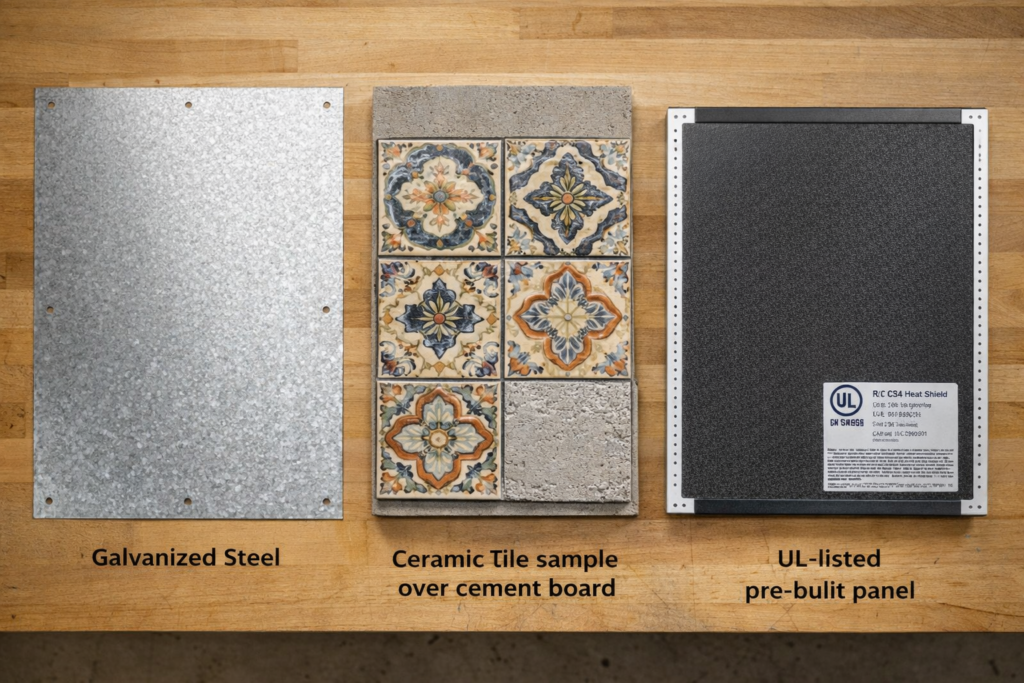
Not all wood stove heat shield options are created equal. The right choice depends on your wall material, stove placement, budget, and aesthetic preferences. Here’s a breakdown of the main types you’ll encounter.
Sheet Metal Wall Shields
The most common and affordable wood stove heat shield option is a sheet metal panel, typically 24-gauge galvanized or stainless steel. Sheet metal shields are effective, durable, and easy to fabricate. You can buy pre-cut panels at most hardware stores or have them cut to size at a metal shop.
The key to a sheet metal wood stove heat shield is the air gap. The panel must be mounted at least 1 inch away from the wall using non-combustible ceramic or metal spacers. This gap allows convection cooling, where cooler air enters at the bottom, flows behind the shield, and exits at the top, continuously removing heat from the wall surface. Without this gap, a sheet metal wood stove heat shield is significantly less effective.
Sheet metal shields typically allow clearance reduction from 36 inches to 12-18 inches, depending on the specific configuration. They’re the go-to choice for utility installations like garages, workshops, and cabins where appearance is secondary to function.
Tile and Stone Wood Stove Heat Shield
For living rooms and finished spaces, a tile or stone wood stove heat shield offers the same protection as sheet metal but with far better aesthetics. Ceramic tile, natural stone, slate, and brick veneer all make excellent wood stove heat shield materials when installed correctly over a non-combustible substrate like cement board.
The installation process for a tile wood stove heat shield involves mounting cement board to the wall (with the required 1-inch air gap maintained using spacers), then tiling over the cement board. The result looks like a custom fireplace surround and adds real value to your home’s appearance.
One thing many people miss: the tile itself isn’t the wood stove heat shield, the entire assembly (cement board plus tile, mounted with an air gap) is. Tile glued directly to drywall without an air gap doesn’t meet code requirements, no matter how thick the tile is. The Hearth, Patio & Barbecue Association provides installation guidelines that clarify this distinction for homeowners and contractors.
UL-Listed Pre-Built Wood Stove Heat Shield Panels
If you want the simplest installation with guaranteed code compliance, UL-listed pre-built wood stove heat shield panels are the way to go. These panels are tested and certified under UL 1618 (the standard for wall protectors for solid fuel appliances) and come with documented clearance reduction values.
Pre-built panels typically consist of a decorative facing (often stainless steel or painted steel) over a non-combustible core, with built-in spacer legs that maintain the required air gap automatically. You mount them directly to the wall, and the clearance reduction is guaranteed by the UL listing. No guesswork, no custom fabrication, no code questions.
The downside is cost. Pre-built UL-listed wood stove heat shield panels run $150-$400 depending on size, compared to $30-$80 for a DIY sheet metal version. But for homeowners who want a clean, professional result without the hassle of custom fabrication, they’re worth every penny.
Hearth Pads (Floor-Level Wood Stove Heat Shield)
The floor-level wood stove heat shield, or hearth pad, comes in several forms. Pre-made hearth pads are available in standard sizes and materials including tile, stone, slate, and composite materials. They sit directly on the floor and provide the required non-combustible surface under and around the stove.
Custom hearth pads can be built using cement board as a base, topped with tile or stone. This approach lets you match the floor-level wood stove heat shield to your room’s décor. The minimum thickness for a hearth pad depends on the floor material underneath, but most building codes require at least R-value equivalent protection for combustible floors.


Wood Stove Heat Shield Materials: What Works and What Doesn’t
Choosing the right material for your wood stove heat shield is more important than most people realize. Not every “non-combustible” material performs equally, and some popular DIY choices actually fail to meet code requirements. Here’s a clear breakdown of what works, what doesn’t, and why.
Materials That Work Well
| Material | Effectiveness | Cost | Appearance | Notes |
|---|---|---|---|---|
| 24-gauge galvanized steel | Excellent | Low ($30-$60) | Industrial | Requires 1″ air gap |
| Stainless steel sheet | Excellent | Medium ($60-$120) | Modern/clean | More durable than galvanized |
| Ceramic tile over cement board | Excellent | Medium ($80-$200) | Decorative | Must maintain air gap |
| Natural stone (slate, granite) | Excellent | High ($150-$400) | Premium | Heavy, needs solid mounting |
| Brick veneer over cement board | Excellent | Medium ($100-$250) | Traditional | Classic look, very durable |
| UL 1618-listed panels | Excellent | High ($150-$400) | Varies | Guaranteed code compliance |
| Cement board alone | Good | Low ($20-$40) | Utilitarian | Works but not decorative |
Materials That Don’t Work (Common Mistakes)
This is where I see homeowners get into trouble. Several materials seem like they should work as a wood stove heat shield but actually don’t meet code requirements or perform poorly in practice.
Drywall, even fire-rated Type X drywall, is not an acceptable wood stove heat shield material. It’s combustible enough to fail over time under sustained radiant heat. Many homeowners assume that “fire-rated” means it can handle stove proximity. It can’t. Type X drywall is rated for fire resistance in wall assemblies, not for direct radiant heat exposure from a wood stove.
Thin decorative tile glued directly to drywall without an air gap is another common mistake. The tile itself is non-combustible, but the drywall behind it isn’t, and without the ventilated air gap, heat conducts right through the tile into the wall. This setup looks like a wood stove heat shield but doesn’t function as one.
Plywood or OSB, even painted or treated, is absolutely not acceptable as a wood stove heat shield material. I’ve seen this in older installations, and it’s genuinely dangerous. If you find plywood behind your stove, replace it immediately.
The EPA’s Burn Wise guidelines emphasize that proper installation, including correct wood stove heat shield materials, is as important as choosing an efficient stove. A great stove installed incorrectly is still a fire hazard.
How to Build a DIY Wood Stove Heat Shield Step by Step
Building your own wood stove heat shield is a realistic DIY project for most homeowners. A basic sheet metal version takes about 2-3 hours and costs $50-$100 in materials. Here’s the complete process.
What You’ll Need
- 24-gauge galvanized or stainless steel sheet (sized to cover stove width plus 18 inches on each side)
- Non-combustible ceramic or metal spacers (1-inch minimum, available at hardware stores)
- Lag screws or toggle bolts appropriate for your wall type
- Drill and bits
- Level
- Tape measure
- Tin snips or metal shears (if cutting to size)
- Safety glasses and gloves
Step 1: Measure and Plan
Measure the width of your stove and add 18 inches to each side. That’s the minimum width of your wood stove heat shield. For height, the shield must extend from the floor (or hearth pad) to at least 18 inches above the top of the stove. Mark these dimensions on your wall with a pencil.
Double-check your stove’s installation manual for any manufacturer-specific wood stove heat shield requirements. Some stoves specify different clearance reduction values than the NFPA 211 defaults. The more restrictive requirement always applies.
Step 2: Locate Wall Studs
Use a stud finder to locate the wall studs within your marked area. You’ll want to anchor the wood stove heat shield spacers into studs for maximum security. Mark stud locations clearly. If studs don’t fall in convenient locations, use appropriate toggle bolts rated for the weight of your shield assembly.
Step 3: Install the Spacers
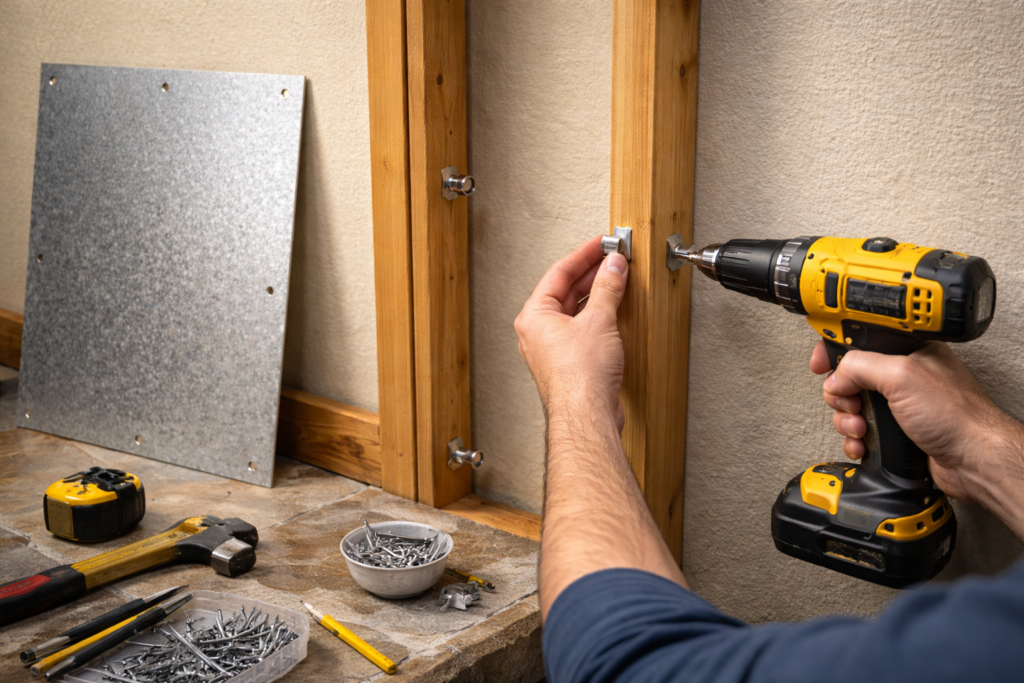
This is the most critical step. The spacers create the ventilated air gap that makes your wood stove heat shield actually work. Install non-combustible spacers at each mounting point, maintaining a consistent 1-inch gap between the wall surface and the back of the shield panel. Use at least four spacers for a standard-sized shield, one near each corner.
The spacers must be non-combustible. Metal standoffs, ceramic insulators, or masonry anchors all work. Never use wood blocks, plastic spacers, or rubber grommets as spacers for a wood stove heat shield. They’ll degrade under heat and compromise the air gap.
Step 4: Mount the Shield Panel
Attach the sheet metal panel to the spacers using appropriate fasteners. Make sure the panel is level and sits flat against all spacers. Leave the top and bottom edges open, don’t seal them. The open top and bottom allow air to circulate behind the wood stove heat shield, which is what makes the convection cooling work.
If your shield is large or heavy, have a helper hold it in position while you drive the fasteners. Sheet metal edges are sharp, so wear gloves throughout this step.
Step 5: Verify Clearances and Test
With the wood stove heat shield installed, re-measure the clearance from your stove’s outer surface to the face of the shield. This new clearance must meet the reduced clearance value specified by NFPA 211 for your shield configuration (typically 12-18 inches with a properly built ventilated shield).
Run your stove for a full burn cycle and check the wall temperature behind the shield using an infrared thermometer. The wall surface should stay below 117°F (the threshold above which sustained heat can begin pyrolysis in wood framing). If the wall is getting hotter than that, your shield needs adjustment, either a larger panel, better spacers, or both.
For a complete reference on the code requirements your DIY wood stove heat shield must meet, our wood stove heat shield requirements guide covers every NFPA 211 specification in detail. It’s worth reading before you start building.
Wood Stove Heat Shield Clearance Reduction: The Numbers You Need
Understanding exactly how much clearance reduction a wood stove heat shield provides is essential for planning your installation. These numbers come directly from NFPA 211 and apply to properly constructed shields with the required 1-inch ventilated air gap.
| Shield Configuration | Standard Clearance | Reduced Clearance | Reduction % |
|---|---|---|---|
| No shield | 36 inches | 36 inches | 0% |
| Single-layer sheet metal with 1″ air gap | 36 inches | 18 inches | 50% |
| Double-layer sheet metal with 1″ air gap | 36 inches | 12 inches | 67% |
| UL 1618-listed panel (varies by product) | 36 inches | 12-18 inches | 50-67% |
| Masonry (brick/stone) with 1″ air gap | 36 inches | 12 inches | 67% |
| Stove-mounted manufacturer shield | 36 inches | Per stove manual | Varies |
These clearance reductions apply to the wall behind and beside the stove. The clearance in front of the stove (the loading zone) is not reduced by a wood stove heat shield, it’s determined by the stove’s design and your local code. Always verify the specific clearance values in your stove’s installation manual, as manufacturer requirements sometimes differ from NFPA 211 defaults.
One thing worth noting: the clearance reduction only applies to the area covered by the wood stove heat shield. If your shield doesn’t extend far enough to the sides or top, the uncovered wall sections still require the full 36-inch clearance. Size your shield generously, the 18-inch extension beyond the stove on each side is a minimum, not a target.
If you’re planning a new stove installation and want to understand how clearances affect your options, our off-grid cabin heating options guide discusses how different stove placements and wood stove heat shield configurations work in small spaces.
Common Wood Stove Heat Shield Mistakes to Avoid
I’ve inspected a lot of wood stove installations over the years, and the same wood stove heat shield mistakes show up repeatedly. Here’s what to watch out for.
Skipping the Air Gap
This is the most dangerous mistake. A wood stove heat shield mounted flush against the wall, with no air gap, provides almost no protection. The heat conducts directly through the shield material into the wall. The ventilated air gap is what makes the wood stove heat shield work, without it, you’ve just added a decorative panel that creates a false sense of security.
Always use non-combustible spacers and always leave the top and bottom of the shield open for airflow. This is non-negotiable for a functional wood stove heat shield.
Making the Shield Too Small
A wood stove heat shield that only covers the area directly behind the stove leaves the adjacent wall sections unprotected. Radiant heat spreads in all directions, not just straight back. The 18-inch extension requirement on each side and above the stove exists because heat radiates at angles, not just perpendicular to the stove face.
When in doubt, make your wood stove heat shield bigger. There’s no penalty for a shield that’s larger than the minimum, and the extra coverage provides real additional protection.
Using the Wrong Fasteners
Plastic anchors, nylon spacers, and standard wood screws are not appropriate for wood stove heat shield installation. Use metal fasteners throughout. Plastic and nylon components can melt or degrade under sustained heat, causing the shield to loosen or fall. Metal screws, metal spacers, and metal anchors only.
Forgetting the Floor
Wall protection gets all the attention, but floor protection is equally important. A wood stove heat shield on the wall doesn’t protect the floor. If you’re on a combustible floor, you need a hearth pad that meets the size requirements. Many homeowners install a beautiful wall wood stove heat shield and then place the stove directly on hardwood flooring. That’s a code violation and a fire risk.
Not Checking the Stove Manual
NFPA 211 sets the baseline, but your stove’s manufacturer may have different requirements. Some stoves have built-in shielding that allows reduced clearances without a separate wood stove heat shield. Others require larger clearances than NFPA 211 specifies. Always read the installation manual before planning your wood stove heat shield configuration.
The Chimney Safety Institute of America recommends having your installation inspected by a certified chimney professional before your first fire, especially if you’ve built a custom wood stove heat shield. A professional can spot clearance issues and code violations before they become dangerous.


Wood Stove Heat Shield for Specific Installation Scenarios
Different installation situations call for different wood stove heat shield approaches. Here’s how to handle the most common scenarios.
Corner Installations
Corner installations are the most challenging wood stove heat shield situation because you need protection on two walls simultaneously. Both walls require their own wood stove heat shield panels, and the corner itself needs special attention since heat can concentrate there.
For corner installations, build two separate wood stove heat shield panels that meet at the corner, or use a single L-shaped panel. The air gap must be maintained on both walls. Corner installations often benefit from a slightly larger shield than the minimum, since the geometry concentrates heat in the corner area.
Basement and Low-Ceiling Installations
Basements often have lower ceilings than main living areas, which can create ceiling clearance issues. If your ceiling is less than 36 inches above the top of the stove, you need a ceiling-mounted wood stove heat shield. The same principles apply: non-combustible material, 1-inch air gap, open edges for airflow.
Basement installations also frequently involve combustible walls (wood framing with drywall) on all sides, making a comprehensive wood stove heat shield plan essential. Map out all surfaces within 36 inches of the stove before you start, and plan protection for each one.
Cabin and Tiny Home Installations
Small spaces make wood stove heat shield planning critical because there’s simply less room to work with. In a 200-square-foot cabin, a 36-inch clearance requirement on all sides might take up more floor space than the stove itself. A properly built wood stove heat shield that reduces clearances to 12 inches can make the difference between a workable installation and an impossible one.
For cabin installations, I always recommend starting with the smallest stove that meets your heating needs, then planning the wood stove heat shield configuration around it. Our guide on budget wood stoves under $1,500 includes compact models that work well in tight spaces with reduced clearance wood stove heat shield setups. If you’re heating off-grid, also check our off-grid cabin heating options for stove sizing guidance.
Retrofit Installations (Existing Stove, New Shield)
If you’re adding a wood stove heat shield to an existing installation that currently lacks one, the process is the same as a new installation, but you need to work around the stove that’s already in place. Move the stove away from the wall temporarily if possible, install the shield, then reposition the stove to the correct clearance distance from the shield face.
If the stove can’t be moved (due to stovepipe connections), you may need to install the wood stove heat shield in sections. This is more complex but achievable. Just make sure the air gap is maintained throughout and all sections are properly secured.
Wood Stove Heat Shield Maintenance and Inspection
A wood stove heat shield isn’t a set-it-and-forget-it component. It needs periodic inspection to ensure it’s still doing its job. Here’s what to check and when.
Annual Inspection Checklist
Once per year, before heating season, inspect your wood stove heat shield for these issues:
- Check all fasteners and spacers for looseness or corrosion. Tighten or replace as needed.
- Verify the air gap is still maintained at 1 inch minimum. Shields can shift over time.
- Inspect the shield surface for warping, discoloration, or rust. Minor surface rust on galvanized steel is cosmetic, but deep rust that compromises the panel’s integrity requires replacement.
- Check that the top and bottom edges remain open and unobstructed. Dust, debris, or stored items blocking the airflow paths reduce the wood stove heat shield’s effectiveness.
- Inspect the wall behind the shield (if accessible) for any signs of heat damage, discoloration, or charring. Any wall damage indicates the wood stove heat shield isn’t performing adequately.
- For tile or stone shields, check for cracked grout or loose tiles. Gaps in the facing material can allow heat to concentrate in specific spots.
The NFPA 211 standard recommends annual inspection of all solid fuel appliance components, including wood stove heat shield assemblies. If you’re having your chimney professionally swept, ask the technician to inspect the wood stove heat shield at the same time. Most certified chimney sweeps are trained to evaluate wood stove heat shield installations as part of a comprehensive inspection.
When to Replace Your Wood Stove Heat Shield
A well-built wood stove heat shield should last 10-20 years with proper maintenance. Replace it when you see significant warping that prevents flat mounting, deep corrosion that compromises the panel’s structural integrity, or any evidence that the wall behind the shield has been damaged by heat. Don’t wait for a problem to become serious before replacing a compromised wood stove heat shield.
If you’re replacing other stove components at the same time, it’s a good opportunity to upgrade your wood stove heat shield as well. Our guides on wood stove glass door replacement and ash pan replacement cover other common maintenance upgrades that often happen alongside a wood stove heat shield refresh.
Frequently Asked Questions
What is the minimum clearance with a wood stove heat shield?
With a properly built wood stove heat shield featuring a 1-inch ventilated air gap, NFPA 211 allows clearance reduction to 12-18 inches depending on the shield configuration. A single-layer sheet metal shield reduces clearance from 36 inches to 18 inches. A double-layer shield or masonry assembly can reduce it to 12 inches. Always verify with your stove’s installation manual, as manufacturer requirements may differ.
Can I use drywall as a wood stove heat shield?
No. Even fire-rated Type X drywall is not an acceptable wood stove heat shield material. Drywall is combustible enough to fail under sustained radiant heat from a wood stove. Acceptable materials include sheet metal (24-gauge minimum), ceramic tile over cement board, natural stone, brick veneer, and UL 1618-listed panels, all mounted with a 1-inch ventilated air gap.
Does a wood stove heat shield need an air gap?
Yes, the air gap is essential. A wood stove heat shield mounted flush against the wall without an air gap provides almost no protection because heat conducts directly through the shield material into the wall. The 1-inch minimum air gap allows convection cooling, where cooler air circulates behind the shield and continuously removes heat from the wall surface. The top and bottom of the shield must remain open for this airflow to work.
How big does a wood stove heat shield need to be?
A wood stove heat shield must extend at least 18 inches beyond the sides and top of the stove, and from the floor (or hearth pad) upward. So if your stove is 24 inches wide, the shield must be at least 60 inches wide (24 + 18 + 18). Height should reach at least 18 inches above the stove’s top surface. Bigger is always better, the 18-inch extension is a minimum, not a target.
Can I build my own wood stove heat shield or do I need to buy one?
You can absolutely build your own wood stove heat shield. A DIY sheet metal version costs $50-$100 in materials and takes 2-3 hours to build and install. The key requirements are using non-combustible materials, maintaining a 1-inch ventilated air gap with non-combustible spacers, and sizing the shield correctly. If you want guaranteed code compliance without custom fabrication, UL 1618-listed pre-built panels are available for $150-$400.
Does a wood stove heat shield protect the floor too?
A wall-mounted wood stove heat shield only protects the wall. Floor protection requires a separate hearth pad (floor-level heat shield) that extends at least 18 inches in front of the stove door and 8 inches on all other sides. If your stove sits on a combustible floor like hardwood, laminate, or carpet, a hearth pad is required regardless of whether you have a wall shield.
What happens if I don’t install a wood stove heat shield?
Without a wood stove heat shield, your stove must maintain 36 inches of clearance from all combustible surfaces. If the stove is closer than that without a shield, the sustained radiant heat can cause pyrolysis in wood framing and wall materials over time, eventually leading to ignition even without direct flame contact. This is a real fire risk, not a theoretical one. It’s also a code violation that can affect your homeowner’s insurance coverage.
Final Thoughts on Wood Stove Heat Shield Installation
A wood stove heat shield is one of the most important safety components in any wood stove installation, and it’s also one of the most straightforward to get right. The principles are simple: non-combustible material, 1-inch ventilated air gap, correct sizing, and proper fasteners. Follow those four rules and you’ll have a wood stove heat shield that’s both code-compliant and genuinely protective.
Whether you build a $60 sheet metal version or invest in a $300 tile-and-stone assembly, the wood stove heat shield you install today protects your home for decades. Don’t skip it, don’t cut corners on the air gap, and don’t assume that “close enough” is good enough when it comes to fire safety.
If you’re still working through your installation plan, our detailed wood stove heat shield requirements guide covers every NFPA 211 specification you need. For the bigger picture on wood stove safety and efficiency, explore our guides on venting mistakes that cost you heat, reducing wood stove smoke, and choosing the right stove for your budget. Stay safe, stay warm.
