
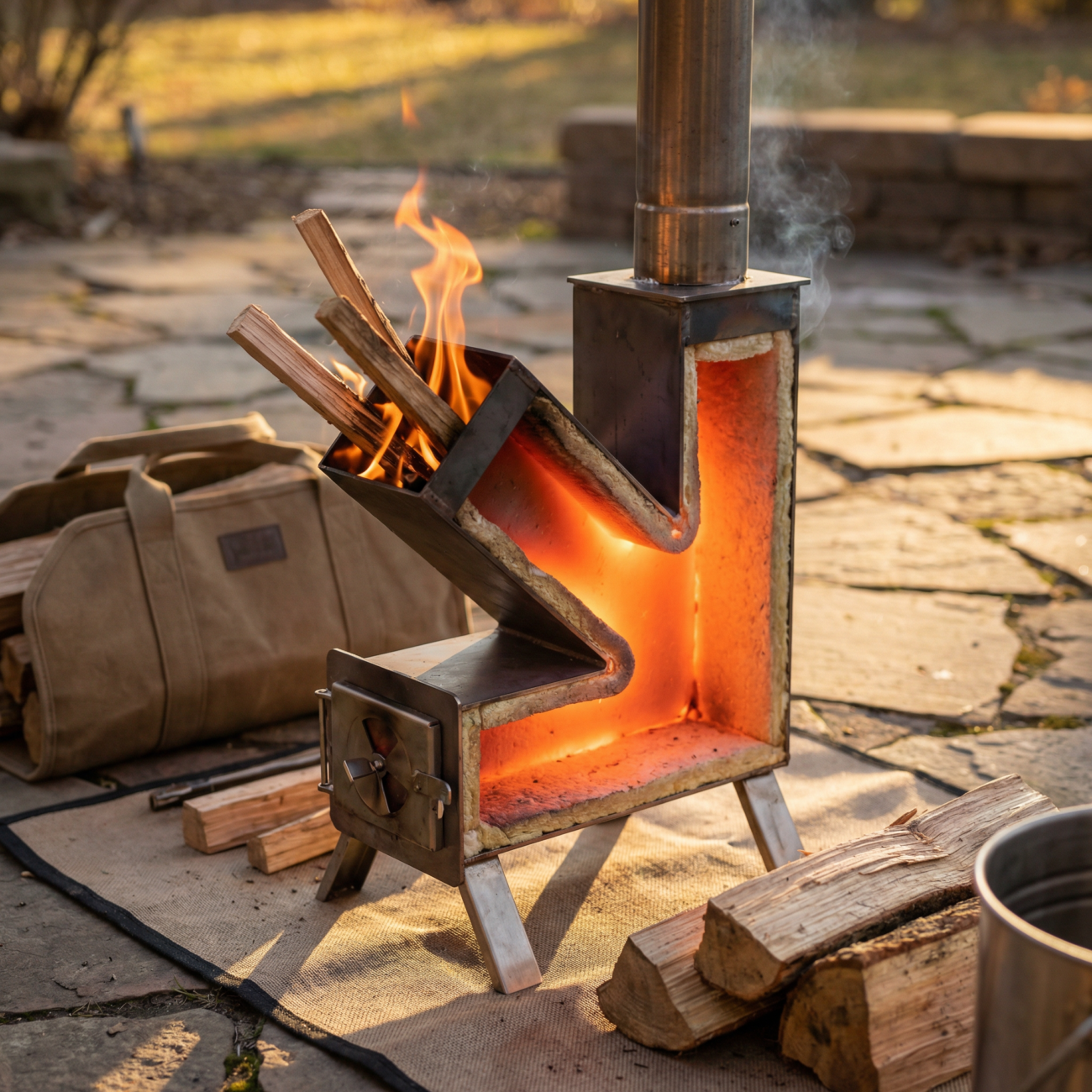
Ever watched a traditional wood stove devour your carefully stacked firewood while barely heating your space? There’s a better way. A rocket stove wood burning heater can deliver the same heat using up to 90% less wood, and it’s not magic, just brilliant engineering that’s been hiding in plain sight for decades.
A rocket stove wood burning heater is an ultra-efficient wood burning system that uses a unique J-shaped or L-shaped combustion chamber to create extremely high temperatures (over 1,800°F) with minimal fuel. Unlike conventional wood stoves that waste heat up the chimney, a rocket stove wood burning heater forces hot gases through an insulated burn tunnel, achieving near-complete combustion that extracts maximum energy from every stick of wood.
If you’re tired of feeding your regular wood stove like it’s a hungry beast, or you’re looking for an off-grid heating solution that won’t break the bank or your back, you’re going to want to understand how these ingenious heaters work. Whether you’re considering buying one, building your own, or just curious about why survivalists and homesteaders won’t shut up about them, this guide breaks down everything you need to know about rocket stove wood burning heater technology, efficiency, and practical applications.
What Makes a Rocket Stove Wood Burning Heater Different
Traditional wood stoves operate on a pretty straightforward principle: burn wood, create heat, send some of it into your room and a lot of it up the chimney. A rocket stove wood burning heater flips that wasteful approach on its head.
The key difference lies in the combustion chamber design. Where a regular wood stove has a large firebox that accepts big logs, a rocket stove wood burning heater uses a narrow, vertical feed tube combined with an insulated burn tunnel. This creates what engineers call “high-draft combustion,” essentially a controlled tornado of fire that burns so hot and completely that you’ll barely see smoke coming from the chimney.
Think of it this way: your traditional wood stove is like an open campfire, maybe 15-30% efficient on a good day. A modern EPA-certified wood stove might hit 70-78% efficiency. A well-designed rocket stove wood burning heater? We’re talking 85-95% efficiency, with some designs pushing even higher.
The Core Components
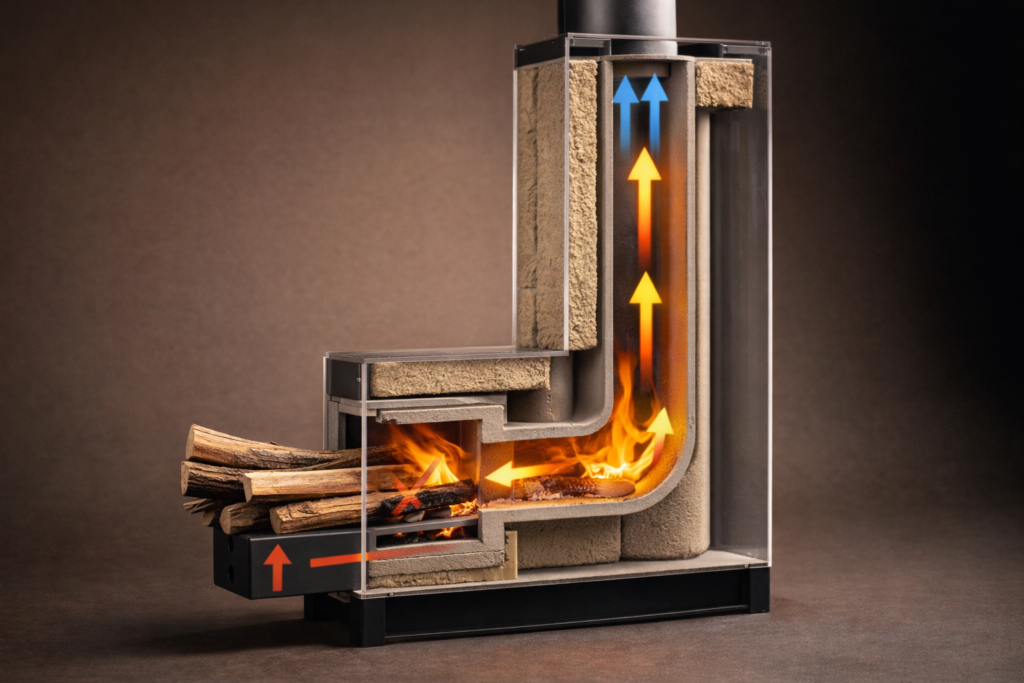
Every rocket stove wood burning heater, whether it’s a simple camping version or a whole-house rocket mass heater, shares these fundamental parts:
- Feed tube: This vertical or angled chamber is where you insert your fuel. Unlike traditional stoves where you load logs horizontally, a rocket stove wood burning heater typically accepts wood sticks fed vertically. Gravity becomes your friend here, as wood automatically feeds into the combustion zone as it burns.
- Combustion chamber: This is where the magic happens. The insulated burn tunnel, usually lined with firebrick, ceramic, or other refractory material, gets incredibly hot. According to the U.S. Department of Energy, temperatures in this zone can exceed 2,000°F in optimal conditions, far hotter than conventional wood stoves.
- Heat riser: Hot gases shoot up through this insulated vertical channel, creating powerful draft that pulls fresh air into the combustion zone. This is the “rocket” effect that gives the rocket stove wood burning heater its name and its characteristic roar when burning.
- Heat exchanger: In portable versions, this might be a simple cooking surface. In heating applications, it’s often a long horizontal run of stovepipe or a massive thermal mass of cob, brick, or stone that absorbs and radiates heat long after the fire goes out.
The National Fire Protection Association emphasizes that any wood burning appliance requires proper clearances and installation, and rocket stove wood burning heater systems are no exception, though their external surfaces often run cooler than traditional stoves.



How Rocket Stove Wood Burning Heater Technology Works
Understanding the science behind a rocket stove wood burning heater helps you appreciate why it’s so efficient and how to operate one effectively.
The combustion process in a rocket stove wood burning heater happens in distinct stages, all occurring simultaneously in different parts of the system. When you light the fire and feed small sticks into the feed tube, they begin gasifying, releasing volatile compounds as they heat up.
These gases get sucked into the insulated burn tunnel where, thanks to the intense heat and abundant oxygen, they combust almost completely. This secondary combustion is what makes a rocket stove wood burning heater so clean-burning. Most wood smoke is actually unburned fuel, but a rocket stove wood burning heater captures and burns those gases before they can escape.
The hot combustion gases then rush up the heat riser, creating a strong draft through the Venturi effect. This draft pulls more oxygen-rich air into the combustion zone, feeding the fire and maintaining those crazy-high temperatures. It’s a self-sustaining cycle that continues as long as you keep feeding fuel into the system.
The Insulation Factor
Here’s something most people don’t realize about a rocket stove wood burning heater: the insulation around the burn tunnel isn’t just about efficiency, it’s absolutely critical to the entire system functioning properly.
Without proper insulation, the combustion chamber can’t reach the temperatures needed for complete combustion. You end up with a smoky, inefficient fire that defeats the whole purpose of the rocket stove wood burning heater design. This is why DIY builders need to pay serious attention to using proper refractory materials, not just whatever bricks they found in the backyard.
Materials like perlite, vermiculite, ceramic fiber blanket, or pumice provide the insulation needed to maintain 1,800°F+ temperatures. Some rocket stove wood burning heater designs use a metal burn tunnel surrounded by these insulators, while others use solid firebrick or refractory ceramic.
Air Flow Dynamics
The air flow pattern in a rocket stove wood burning heater is precisely controlled, unlike the somewhat chaotic air patterns in a traditional wood stove. Primary air enters through the feed tube, mixing with fuel. Secondary air can enter at the junction between the feed tube and the burn tunnel, ensuring complete combustion of the gases.
The beauty of this design is that it’s nearly impossible to “choke” the fire by restricting air flow too much. The natural draft created by the heat riser keeps everything moving. That said, you can adjust the burn rate of a rocket stove wood burning heater by controlling how much fuel you feed it and, in some designs, by using a damper at the feed tube opening.
Rocket Stove Wood Burning Heater Efficiency Explained
Let’s talk numbers, because the efficiency claims about rocket stove wood burning heater systems sound almost too good to be true. How can they really be that much better than modern wood stoves?
The efficiency of any wood burning appliance comes down to how much of the fuel’s energy actually becomes usable heat versus how much goes up the chimney or remains in ashes. A rocket stove wood burning heater excels in three key areas: combustion efficiency, heat transfer efficiency, and thermal mass utilization.
Combustion efficiency in a rocket stove wood burning heater approaches near-complete fuel consumption. Where a traditional wood stove might leave chunky charcoal and creosote deposits, a properly operating rocket stove wood burning heater produces fine white ash and virtually no creosote. The EPA’s studies on clean wood burning show that complete combustion not only improves efficiency but dramatically reduces particulate emissions.
Fuel Consumption Comparison
Here’s where things get interesting. Let’s compare actual wood usage:
| Heating Method | Wood Per Hour | Heat Duration | Daily Wood Use |
|---|---|---|---|
| Open Fireplace | 15-20 lbs | Constant feeding | 200-300 lbs |
| Older Wood Stove | 8-12 lbs | 3-4 hours | 80-120 lbs |
| EPA Wood Stove | 4-6 lbs | 6-8 hours | 40-60 lbs |
| Rocket Stove Wood Burning Heater | 1.5-3 lbs | 2-4 hours active, 12+ hours with mass | 15-30 lbs |
Those aren’t typos. A rocket stove wood burning heater can heat a similar space using 50-80% less wood than even a modern EPA-certified stove. The catch? You’re feeding smaller pieces more frequently during active burning, though a rocket mass heater stores enough heat to radiate warmth for hours or even days after the fire goes out.
This efficiency means a cord of wood that might last you one month in a traditional wood stove could last three to four months in a rocket stove wood burning heater system. If you’re buying firewood, that’s serious money saved. If you’re cutting your own, that’s your weekends back.
Heat Output and Temperature Control
A common misconception about rocket stove wood burning heater systems is that you can’t control the heat output. That’s partly true and partly false, depending on the design.
During active burning, a rocket stove wood burning heater runs hot, period. You can’t really “turn it down” like you might damper a traditional wood stove. However, you control the heat output by how much and how often you feed it. Want less heat? Feed it less frequently or use thinner sticks. Want more heat? Feed it more often with slightly larger diameter wood.
In rocket mass heater applications, the thermal mass acts as a battery, storing heat during short, intense burns and releasing it gradually over 12-24 hours. This means you might burn for just 2-3 hours in the morning and evening, yet maintain comfortable temperatures all day and night. Try doing that with your regular wood stove.
The Hearth, Patio & Barbecue Association notes that while rocket stove wood burning heater technology isn’t mainstream in the U.S. hearth industry yet, international markets, particularly in developing regions, have validated the efficiency claims through extensive real-world use.
Types of Rocket Stove Wood Burning Heater Systems
Not all rocket stove wood burning heater designs serve the same purpose. Understanding the different types helps you choose the right one for your needs.
Portable Rocket Stoves

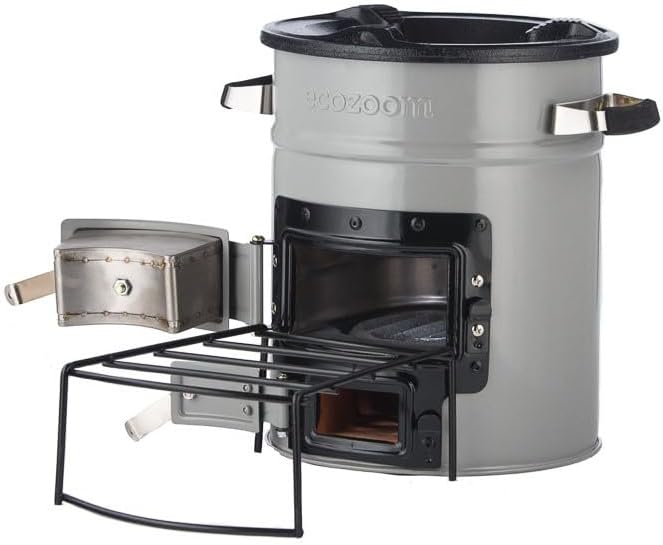
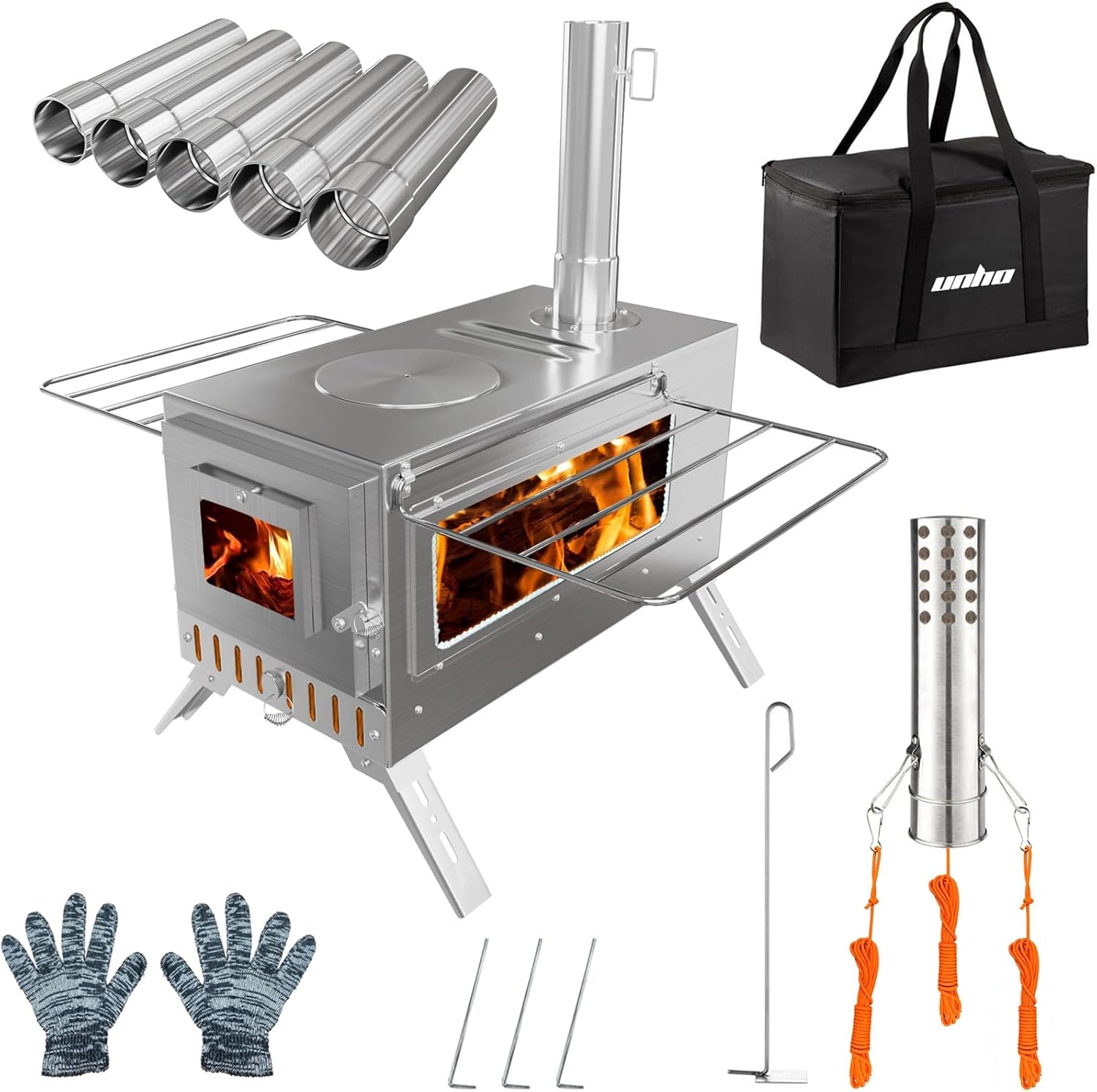
These compact units are the gateway drug to rocket stove wood burning heater technology for most people. Designed primarily for cooking, portable rocket stoves weigh anywhere from 5 to 25 pounds and can fit in a backpack or emergency kit.
A portable rocket stove wood burning heater typically features a small feed tube, insulated combustion chamber, and a top cooking surface. Brands like EcoZoom, SilverFire, and StoveTec have refined these designs to be incredibly user-friendly. You can boil water in 4-5 minutes using nothing but small twigs and sticks, no split firewood required.
Emergency preparedness folks love portable rocket stove wood burning heater models because they work with any dry burnable material. No propane canisters, no special fuel, just whatever woody debris you can scavenge. During power outages, a portable rocket stove wood burning heater becomes your cooking and water purification solution.
Rocket Mass Heaters
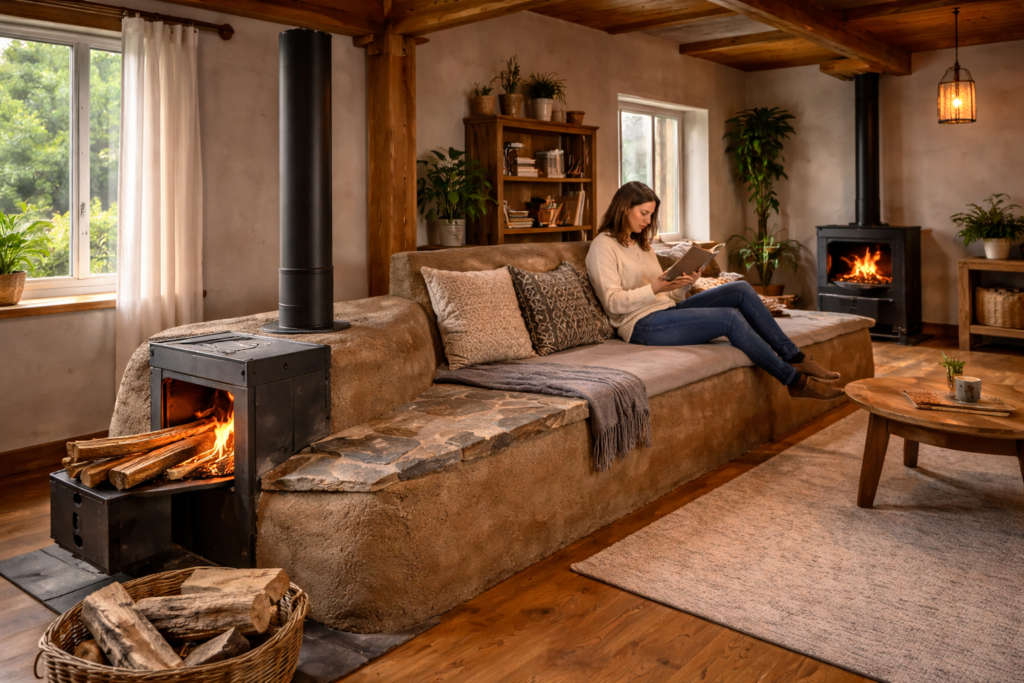
This is where the rocket stove wood burning heater concept really shines for home heating. A rocket mass heater (RMH) combines the efficient combustion of a rocket stove wood burning heater with a massive thermal battery, typically a masonry bench or bed that people can sit or lie on.
The basic design runs the hot exhaust gases through a long horizontal pathway, usually buried in cob (clay, sand, and straw mixture) or masonry. This mass absorbs heat during the burn and radiates it slowly over the next 12-48 hours, depending on the size and insulation.
A well-built rocket mass heater can maintain a 500-800 square foot space at comfortable temperatures with just one or two short burns daily. The surface of the mass stays warm enough to sit on comfortably (around 100-120°F typically), providing radiant heat that feels more comfortable than forced air at similar temperatures.
Building codes are the biggest challenge with rocket mass heaters in the U.S. Most jurisdictions don’t have approval processes for DIY masonry heaters, and getting permits can be difficult. However, some manufacturers now offer code-approved rocket mass heater designs, though they’re pricey.
Batch Box Rocket Stoves
A newer evolution of the rocket stove wood burning heater design, batch box systems allow you to load a larger quantity of wood at once rather than continuously feeding sticks. This addresses one of the main complaints about traditional rocket stove wood burning heater designs: the need for constant feeding.
A batch box rocket stove wood burning heater uses a larger combustion chamber, but maintains the insulated burn tunnel and high-temperature secondary combustion that makes rocket stoves so efficient. You load it with split firewood like a normal wood stove, and it burns through the batch over several hours.
These systems bridge the gap between the ultra-efficiency of a rocket stove wood burning heater and the convenience of traditional wood stove operation. They’re becoming increasingly popular for people who want rocket stove efficiency without the feeding commitment.


Best Uses for a Rocket Stove Wood Burning Heater
Knowing where rocket stove wood burning heater technology excels (and where it doesn’t) helps you make smart decisions about incorporating one into your life.
Off-Grid and Homestead Heating
This is where a rocket stove wood burning heater really proves its worth. If you’re heating with wood as your primary source and you’re processing your own fuel, the efficiency gains are massive. Instead of spending every weekend cutting and splitting cords of firewood, you can get by with smaller diameter material that requires minimal processing.
Many homesteaders build rocket mass heaters into their homes during construction, integrating the thermal mass into the living space as a bench, bed platform, or even floor heating. The ability to maintain warmth with minimal wood consumption means more time for other homestead tasks and less pressure to stockpile enormous quantities of firewood.
The USDA Forest Service has studied sustainable firewood harvesting, and a rocket stove wood burning heater’s ability to utilize smaller diameter wood (2-4 inches) means you can harvest responsibly from material that wouldn’t be worth cutting for a traditional wood stove. This includes orchard prunings, small-diameter thinnings, and fallen branches that would otherwise be left to rot or burned in slash piles.
Emergency Preparedness and Backup Heat
When the power goes out in winter, having a rocket stove wood burning heater, even a simple portable model, can be life-saving. Unlike propane heaters that require stored fuel or generator-powered electric heaters, a rocket stove wood burning heater works with whatever burnable material you can find.
During ice storms or extended outages, when gas stations can’t pump fuel and stores are closed, the ability to heat and cook with sticks from your yard is invaluable. A portable rocket stove wood burning heater should be in every serious emergency kit alongside your CO detector and other safety equipment.
Some preppers maintain both a traditional wood stove for everyday use and a portable rocket stove wood burning heater for emergencies, giving them redundancy in their heating systems. If you’re thinking about emergency preparedness, understanding wood stove insurance requirements is also important.
Workshop and Greenhouse Heating
Spaces that need heat but don’t require all-day warmth are perfect for a rocket stove wood burning heater. A workshop where you spend a few hours at a time can be brought up to comfortable temperatures quickly with a small rocket stove wood burning heater, using minimal fuel.
Greenhouses present an interesting application. A rocket stove wood burning heater can maintain above-freezing temperatures overnight using small amounts of wood, and the CO2 from combustion (when properly vented) can even benefit plant growth. Some designs route the exhaust through beds or growing areas before venting outside, capturing maximum heat.
The key advantage in these applications is the quick heat-up time and efficient fuel use. You’re not wasting wood heating a space when you’re not using it, but you can achieve comfort quickly when you need it.
Outdoor Cooking and Camping
This is where most people first encounter a rocket stove wood burning heater, and it’s an ideal application. Whether you’re car camping, in your backyard, or dealing with an emergency situation, a portable rocket stove wood burning heater provides a stable cooking platform that works in wind and weather conditions that would snuff out a campfire.
Professional outdoor instructors and guides increasingly carry rocket stove wood burning heater models because they require minimal fuel collection, leave minimal impact, and work reliably in backcountry conditions. You can cook a complete meal on a rocket stove wood burning heater using a handful of finger-thick sticks, versus armloads of wood for a traditional campfire.
The efficiency also means less smoke, which matters when you’re cooking in close quarters or trying to stay low-profile in the backcountry. A well-fed rocket stove wood burning heater produces so little smoke that it’s barely noticeable after the initial lighting phase.
DIY Rocket Stove Wood Burning Heater: Is It Worth Building?

The DIY rocket stove wood burning heater movement has exploded online, with countless YouTube videos and blog posts showing people building everything from simple camp stoves to whole-house heating systems. But should you build one?
For portable camping stoves, DIY construction makes sense if you enjoy projects and want to save money. A basic portable rocket stove wood burning heater can be built from salvaged metal cans, brake drums, or cheap sheet metal for under $20. Commercial versions cost $60-$200, so you’re saving significant money if you value your time at less than professional rates.
The plans are widely available for free, and the skills required are minimal: basic metal cutting and assembly, or even simpler if you’re just stacking bricks. A cinder block rocket stove wood burning heater is literally a 15-minute project requiring zero tools, just the right arrangement of blocks.
Building a Rocket Mass Heater
This is where things get complicated. A full-sized rocket mass heater for home heating is a major construction project requiring:
- Materials knowledge: You need to understand refractory materials, thermal mass principles, and proper insulation. Using the wrong materials can result in a smoking, inefficient mess or even a fire hazard.
- Masonry skills: Building the thermal mass bench typically requires working with cob, adobe, or masonry, skills that take practice to develop. Mistakes in construction can mean tearing out tons of material to fix problems.
- Building codes: This is the big one. Most jurisdictions have no provision for owner-built masonry heaters, and getting permits for a DIY rocket mass heater can be impossible. Some areas explicitly prohibit them. Check with your local building department before investing time and money.
- Time and cost: A DIY rocket mass heater can take 2-6 weeks of solid work and cost $1,000-$3,000 in materials even if you’re doing all the labor yourself. Commercial rocket mass heater kits or professionally built systems start around $5,000 and go up from there.
The Environmental Protection Agency’s burn wise program emphasizes that any wood burning appliance should be properly installed and operated to minimize emissions and maximize efficiency. A poorly built rocket stove wood burning heater can actually be worse for air quality than a modern EPA-certified wood stove.


Common DIY Mistakes
Having researched dozens of DIY rocket stove wood burning heater builds, some common problems emerge:
- Insufficient insulation: The most frequent error. Without proper insulation around the burn tunnel, temperatures never reach the threshold for complete combustion. The result is a smoky, creosote-producing fire that defeats the entire purpose.
- Wrong dimensions: The ratio of feed tube diameter to burn tunnel length to heat riser height matters. Random measurements based on available materials often result in poor draft and inefficient burning. Following proven plans is essential.
- Poor sealing: Air leaks anywhere in the system except the intended air inlets cause draft problems and efficiency losses. Every joint needs to be properly sealed with high-temperature materials.
- Thermal mass mistakes: Too much mass and it never warms up. Too little and it doesn’t store enough heat. The wrong mass material (like concrete, which can crack and explode) creates safety hazards.
For most people, starting with a commercially manufactured portable rocket stove wood burning heater makes sense. You learn how the technology works, understand the fuel requirements and operation, and can decide if scaling up to a DIY rocket mass heater project makes sense for your situation.
If you’re serious about a whole-house rocket mass heater, consider taking a workshop from experienced builders or hiring professionals for at least the core combustion unit, then doing the thermal mass work yourself under guidance.
Rocket Stove Wood Burning Heater Maintenance and Operation
Keeping a rocket stove wood burning heater running efficiently requires different maintenance than a traditional wood stove, though in many ways it’s actually simpler.
Daily Operation Best Practices
Starting a rocket stove wood burning heater is straightforward but follows a specific pattern for best results. Begin with a small, hot fire using dry kindling in the feed tube and burn tunnel. Paper or fatwood works great for initial ignition. Once you have flames rising into the heat riser, gradually add larger sticks.
The rocket stove wood burning heater will typically make a roaring sound when it reaches optimal combustion temperature. This is normal and indicates the draft is working correctly. If it’s silent or sounds like a regular fire, something’s wrong with your insulation or air flow.
Feed the rocket stove wood burning heater with dry wood only. Moisture content should be below 20%, preferably 15% or less. A wood moisture meter is a worthy investment for anyone burning wood regularly. Wet wood in a rocket stove wood burning heater will produce smoke, kill your efficiency, and potentially damage the system with steam.
Stick diameter matters. For most rocket stove wood burning heater designs, 1-3 inch diameter wood works best. Larger pieces won’t burn completely, smaller pieces burn too fast. Split wood works better than round branches because it has more surface area for gasification.
Cleaning and Ash Removal
Here’s good news: a properly functioning rocket stove wood burning heater produces minimal ash and virtually no creosote. The ash you do get will be fine, white, and powdery, indicating complete combustion.
For portable units, dumping ash is as simple as tipping the stove over (when completely cold) and tapping it out. Do this every few burns or when you notice ash buildup affecting air flow.
Rocket mass heaters require more thoughtful ash management. The burn tunnel and heat riser should be cleaned periodically, though how often depends on use. Some systems include clean-out ports that make this easier. The horizontal heat exchange passages in the thermal mass should be inspected annually and cleaned if needed, though good combustion means minimal buildup.
Unlike traditional wood stoves where chimney cleaning is a major annual task involving brushes and potentially professional service, a rocket stove wood burning heater chimney (the final vertical exhaust) accumulates very little creosote. You might find some dust and fine ash, but not the tar-like deposits that plague conventional wood stoves.
Troubleshooting Common Issues
- Excessive smoke: This is always a sign something’s wrong. Check for wet wood first, that’s the usual culprit. If wood is dry, check your insulation. Is the burn tunnel maintaining temperature? Are there air leaks pulling draft away from the combustion zone?
- Poor draft: If the rocket stove wood burning heater won’t draw properly or burns weakly, check the heat riser height. It needs to be tall enough to create draft. Also verify the feed tube and burn tunnel aren’t clogged with ash or debris. Some designs need an initial priming fire to heat the mass and establish draft.
- Excessive fuel consumption: If you’re burning through wood faster than expected, you’re either feeding too large pieces (which burn inefficiently) or you have air leaks allowing excess oxygen in. The rocket stove wood burning heater should maintain vigorous combustion on minimal fuel.
- Thermal mass not warming up: In rocket mass heater systems, if the bench or mass stays cold, your exhaust gases aren’t hot enough or you’re burning for too short periods. The mass needs sustained heat input to warm up initially, sometimes several days of regular burning in a large system.
Rocket Stove Wood Burning Heater vs Traditional Wood Stoves
Let’s directly compare rocket stove wood burning heater technology to conventional wood stoves across the factors that actually matter.
| Factor | Traditional Wood Stove | Rocket Stove Wood Burning Heater |
|---|---|---|
| Fuel efficiency | 60-78% (modern EPA) | 85-95%+ |
| Wood consumption | 40-60 lbs/day typical | 15-30 lbs/day typical |
| Fuel size | Large split logs | Small sticks, 1-3 inches |
| Burn time per load | 6-12 hours | 2-4 hours active (12+ with mass) |
| Heat-up time | 30-60 minutes | 10-20 minutes |
| Surface temperature | 400-700°F | Combustion chamber 1800°F+, mass surface 100-120°F |
| Creosote buildup | Significant annual cleaning needed | Minimal to none |
| Installation cost | $2,000-$6,000+ installed | DIY $500-$3,000, commercial $5,000+ |
| Code approval | Widely approved | Limited availability |
| Learning curve | Moderate | Moderate to high |
| Feeding frequency | Every 6-8 hours | Every 1-2 hours during active burn |
The comparison reveals why rocket stove wood burning heater technology hasn’t replaced traditional wood stoves: it requires more active management during burning, and code approval is scarce. However, for fuel efficiency and emissions, the rocket stove wood burning heater is clearly superior.
When Traditional Wood Stoves Make More Sense
Despite the efficiency advantages, a traditional EPA-certified wood stove is often the better choice for primary home heating in conventional houses. Here’s why:
- Code compliance: If you need homeowner’s insurance and building permits, good luck getting approval for a DIY rocket mass heater. A certified wood stove installs straightforwardly with established clearances and procedures.
- Convenience: Loading a wood stove twice a day and walking away beats feeding a rocket stove wood burning heater every hour or two. If you work full-time away from home, the all-day burn time of a traditional stove is essential.
- Resale value: A properly installed EPA-certified wood stove adds value to a home. A rocket mass heater might scare off potential buyers or create financing problems.
- Availability: You can buy a quality wood stove at any hearth shop and have it professionally installed next week. Rocket mass heater systems require either DIY skills or hunting down one of the few commercial builders.
That said, combining both technologies makes sense for some situations. Use a certified wood stove as your primary permitted heating source, and add a portable rocket stove wood burning heater for emergency backup or outdoor cooking.
Understanding 2026 wood stove regulations helps you make code-compliant choices regardless of which technology you pursue.
Cost Analysis: Rocket Stove Wood Burning Heater Economics
Let’s break down what you’ll actually spend on a rocket stove wood burning heater system and how long it takes to recoup your investment.
Initial Investment
Portable camping rocket stoves: $60-$200 commercially, $10-$50 DIY
Mid-sized rocket stove wood burning heater for workshop/small space: $300-$800 commercially, $200-$500 DIY
Full rocket mass heater system: $5,000-$12,000 professionally built, $1,000-$4,000 DIY with materials
Compare this to traditional wood stove installations at $2,500-$6,000 for the stove, pipe, hearth pad, and professional installation, and the rocket mass heater costs look high initially. However, the fuel savings tell a different story over time.
Annual Operating Costs
The big savings with a rocket stove wood burning heater comes from fuel consumption. Let’s model a typical scenario:
Traditional wood stove heating 1,000 sq ft:
- Wood consumption: 4-5 cords per heating season
- Wood cost (buying): $1,000-$1,500 per season
- Wood cost (cutting yourself): $200-$400 in fuel, equipment, time
- Chimney cleaning: $150-$300 annually
Rocket mass heater same space:
- Wood consumption: 1-2 cords per heating season
- Wood cost (buying): $250-$600 per season
- Wood cost (cutting yourself): $50-$150 in fuel, equipment, time
- Chimney cleaning: $0-$50 (minimal creosote)
Annual savings: $500-$1,200 per year depending on whether you buy or cut wood.
If you invested $3,000 in a DIY rocket mass heater, you’d break even in 2.5-6 years compared to buying and installing a traditional wood stove. After that, you’re saving $500-$1,200 annually for the life of the system.
For portable units used for emergency preparedness or camping, the payback calculation is different. Can you put a price on the ability to cook and heat water during a power outage? Most preppers consider a $100-$150 portable rocket stove wood burning heater a bargain insurance policy.
The U.S. Energy Information Administration tracks heating costs across different fuel types. While they don’t specifically track rocket stove wood burning heater systems, the efficiency improvements translate directly to cost savings proportional to the fuel reduction.
Hidden Economic Benefits
Beyond direct fuel savings, a rocket stove wood burning heater offers economic advantages that are harder to quantify:
- Reduced labor: Processing 2 cords of wood takes one-quarter the time of processing 8 cords. If you cut your own, that’s dozens of hours returned to your life each year.
- Fuel flexibility: A rocket stove wood burning heater burns material you might otherwise dispose of, orchard prunings, construction scraps (untreated), yard waste. This isn’t free exactly, but it’s cheaper than buying split firewood.
- Property value: This cuts both ways. An unpermitted rocket mass heater might hurt resale, but a permitted system or even just the ability to demonstrate ultra-low heating costs could attract the right buyer.
- Insurance savings: Some insurers offer discounts for homes with alternative heating sources. A rocket stove wood burning heater as backup heat might qualify, though you’ll need to check with your specific insurance company.
Safety Considerations for Rocket Stove Wood Burning Heater Systems

Any wood burning system presents fire and carbon monoxide risks. Rocket stove wood burning heater designs have unique safety factors you need to understand.
Carbon Monoxide Risks
The good news: a properly functioning rocket stove wood burning heater with complete combustion produces minimal carbon monoxide compared to traditional wood stoves. The bad news: “properly functioning” is key, and outdoor portable units brought indoors for emergencies can create dangerous situations.
Never, ever use a portable rocket stove wood burning heater designed for outdoor cooking inside an enclosed space without proper ventilation. Even the cleanest burning rocket stove produces some CO, and in an enclosed space without exhaust, concentrations can reach lethal levels quickly.
If you’re using a portable rocket stove wood burning heater indoors during an emergency, you need ventilation. Crack windows in multiple rooms to create cross-flow, keep the unit near a window or door, and absolutely maintain working carbon monoxide detectors with fresh batteries.
For permanent rocket mass heater installations, the exhaust must vent completely outside with proper chimney height and draft. The Chimney Safety Institute of America provides guidelines for proper venting that apply to rocket stove wood burning heater systems just as much as traditional wood stoves.
Fire Safety and Clearances
The external surfaces of a rocket mass heater typically run much cooler than a traditional wood stove (around 100-120°F for the bench versus 400-600°F for a stove body), but the combustion unit itself gets extremely hot.
Maintain proper clearances around the feed tube and any exposed metal parts. The exact distances depend on your design and local codes, but figure at least 36 inches from combustibles for unprotected surfaces, less if you install heat shields.
The insulated burn tunnel should never contact combustible materials. If you’re building a rocket mass heater, ensuring the hot components are properly isolated within non-combustible materials is critical. This is where many DIY builds fail inspection, assuming they even attempt to get inspected.
Floor protection matters too. A proper non-combustible hearth pad under the combustion unit is essential, just like with a traditional wood stove. The NFPA 211 standards for chimneys and vents provide guidance, though they don’t specifically address rocket mass heaters.
Operating Safety
- Backdrafting: In rare cases, a rocket stove wood burning heater can backdraft smoke into living spaces, usually during startup or if the system hasn’t been used recently. This happens when cold air has filled the heat riser and chimney. Priming the system with a torch or newspaper fire in the chimney can establish draft before you start the main fire.
- Overheating: It’s hard to overheat a rocket mass heater because the thermal mass acts as a buffer, but the combustion unit itself can be damaged by overfiring. Avoid using accelerants, don’t stuff the feed tube completely full, and never burn trash or treated wood in a rocket stove wood burning heater.
- Fuel management: Keep your fuel storage away from the rocket stove wood burning heater, at least 4 feet of clearance. Small dry sticks are incredibly flammable, and you don’t want your fuel pile igniting from radiant heat or an escaped ember.
- Ash disposal: While a rocket stove wood burning heater produces less ash, it’s still a fire hazard. Only remove ash when the system is completely cold, and store removed ash in a metal container away from combustibles for at least a week before final disposal. Hot coals can smolder in ash for days.
Environmental Impact of Rocket Stove Wood Burning Heater Technology
Beyond personal economics and convenience, rocket stove wood burning heater systems offer genuine environmental benefits, but they’re not a perfect green solution.
The EPA’s position on wood smoke is clear: all wood burning produces particulate matter, and minimizing emissions is important for air quality. A rocket stove wood burning heater excels here because complete combustion means fewer particulates.
Testing done on various rocket stove designs shows particulate emissions 80-95% lower than conventional wood stoves, and even 50-70% lower than modern EPA-certified stoves. The difference is visible, you can literally see it in the exhaust. A properly running rocket stove wood burning heater emits a faint heat shimmer from the chimney, sometimes no visible emissions at all.
Carbon Footprint Considerations
Wood is often called “carbon neutral” because the CO2 released during burning is theoretically equal to what the tree absorbed while growing. That’s somewhat misleading since it ignores the carbon cost of harvesting, processing, and transporting the wood, plus the fact that a standing tree continues to sequester carbon.
A rocket stove wood burning heater improves the carbon equation by requiring less total wood for equivalent heat. If you’re heating with wood anyway, using 70% less fuel means 70% less carbon impact from harvesting, processing, and burning.
There’s also the utilization factor. A rocket stove wood burning heater can efficiently burn material too small for conventional wood stoves, small branches, prunings, wood scraps. This biomass might otherwise decompose (releasing carbon anyway) or be burned inefficiently in burn piles.
Air Quality Trade-offs
Despite the efficiency, burning any solid fuel creates localized air pollution. In urban or suburban areas with many homes, wood smoke from multiple sources creates air quality problems, especially in valley locations where inversions trap smoke.
A rocket stove wood burning heater reduces your personal contribution to this problem, but doesn’t eliminate it. Communities with winter wood smoke issues (think Fairbanks, Alaska, or mountain towns during inversions) increasingly restrict wood burning regardless of the technology used.
If you live in an area with air quality restrictions, check regulations before installing any wood burning system. Some jurisdictions now ban wood burning on certain days regardless of your equipment efficiency.
FAQ: Rocket Stove Wood Burning Heater Questions
What is a rocket stove wood burning heater and how does it work?
A rocket stove wood burning heater is an ultra-efficient wood burning device that uses an insulated J-shaped or L-shaped combustion chamber to create extremely high temperatures (over 1,800°F), achieving 85-95% efficiency. It works by forcing hot gases through an insulated burn tunnel where secondary combustion occurs, eliminating smoke and extracting maximum energy from minimal wood fuel. Unlike traditional wood stoves that waste heat up the chimney, the rocket stove wood burning heater design captures and utilizes nearly all the energy in the wood, reducing fuel consumption by 50-90% compared to conventional stoves.
Can you heat a house with a rocket stove wood burning heater?
Yes, a rocket mass heater variant of the rocket stove wood burning heater can effectively heat entire homes, particularly small to medium-sized spaces of 500-1,500 square feet. The system combines efficient combustion with a large thermal mass (typically a masonry bench) that stores heat during short, hot burns and radiates warmth for 12-24 hours afterward. However, most rocket mass heater installations are DIY projects that face building code challenges, and getting permits in conventional housing can be difficult. For primary home heating with code compliance, most people still need traditional EPA-certified wood stoves, while using portable rocket stove wood burning heater models for backup, emergency heat, or outdoor cooking.
How much wood does a rocket stove wood burning heater use compared to a regular wood stove?
A rocket stove wood burning heater typically uses 50-80% less wood than a traditional wood stove for equivalent heating. Where a conventional wood stove might consume 4-5 cords of firewood per heating season for a 1,000 square foot space, a rocket mass heater can provide similar warmth using just 1-2 cords. Daily consumption drops from 40-60 pounds of wood in a traditional stove to 15-30 pounds in a rocket stove wood burning heater system. This dramatic reduction comes from the near-complete combustion achieved in the insulated burn tunnel, which extracts maximum energy from every stick of wood rather than sending unburned gases and heat up the chimney.
Is a rocket stove wood burning heater safe to use indoors?
A properly designed and installed rocket mass heater is safe for indoor use when built with correct clearances, ventilation, and code compliance. However, portable rocket stove wood burning heater models designed for outdoor cooking should never be used indoors in enclosed spaces without adequate ventilation, as they can produce dangerous carbon monoxide levels. For any indoor rocket stove wood burning heater installation, you need proper exhaust venting to the outside, working carbon monoxide detectors, appropriate clearances from combustible materials (typically 36 inches from unprotected metal parts), and ideally, building permit approval. The combustion chamber reaches over 1,800°F, so fire safety precautions are essential even though external thermal mass surfaces run much cooler than traditional wood stoves.
Can you build a DIY rocket stove wood burning heater, and is it difficult?
Building a simple portable rocket stove wood burning heater for camping is relatively easy and requires minimal skills, basic metal cutting, or even just stacking cinder blocks in the correct configuration. However, constructing a full-sized rocket mass heater for home heating is a complex project requiring knowledge of refractory materials, masonry skills, proper insulation techniques, and correct combustion chamber dimensions. Common DIY mistakes include insufficient insulation around the burn tunnel (preventing the 1,800°F+ temperatures needed for complete combustion), incorrect ratios of components causing poor draft, and thermal mass errors. Building code compliance is the biggest challenge, as most jurisdictions lack approval processes for owner-built rocket mass heaters, making permits difficult or impossible to obtain in many areas.
How much does a rocket stove wood burning heater cost?
Portable camping rocket stove wood burning heater models cost $60-$200 commercially or $10-$50 for DIY builds using salvaged materials. Mid-sized units for workshops or small spaces run $300-$800 commercially or $200-$500 for DIY projects. Full rocket mass heater systems for home heating cost $5,000-$12,000 when professionally built, or $1,000-$4,000 for DIY construction including all materials like firebrick, insulation, metal components, and thermal mass materials. While initial costs can exceed traditional wood stove installations ($2,500-$6,000), the rocket stove wood burning heater typically pays for itself within 2-6 years through fuel savings of $500-$1,200 annually, since it uses 50-80% less firewood to produce equivalent heat.
Conclusion
A rocket stove wood burning heater represents a fundamentally different approach to wood burning, one that prioritizes efficiency and complete combustion over the familiar operation of traditional wood stoves. Whether you’re looking at a $100 portable camping model or contemplating a whole-house rocket mass heater installation, the core technology delivers on its promises: dramatically reduced fuel consumption, minimal emissions, and the ability to create heat from material most stoves can’t efficiently burn.
The trade-offs are real too. You’re exchanging convenience for efficiency, accepting more active fire management during burns in exchange for using a fraction of the wood. Code compliance challenges mean rocket mass heaters remain fringe technology in conventional housing, though that’s slowly changing as manufacturers develop approved models and building officials gain familiarity with the systems.
For off-gridders, homesteaders, emergency preparedness advocates, and anyone serious about reducing heating costs and environmental impact, exploring rocket stove wood burning heater technology makes sense. Start small with a portable unit. Learn how it works. Understand the fuel requirements and operational rhythm. Then decide if scaling up to a larger system fits your situation, skills, and local regulations.
The efficiency gains aren’t hype, they’re physics. Complete combustion extracts more energy from wood, period. Whether that efficiency is worth the learning curve and potential code complications depends on your specific circumstances, but there’s no denying the rocket stove wood burning heater has earned its place in the sustainable heating conversation.
