
Walking into a woodworking store for the first time can feel overwhelming. You’re staring at thousands of tools, each promising to be “essential,” and your budget is already screaming for mercy. I’ve been there, and here’s what nobody tells you upfront: you don’t need half the stuff that’s marketed to beginner woodworking tools buyers.
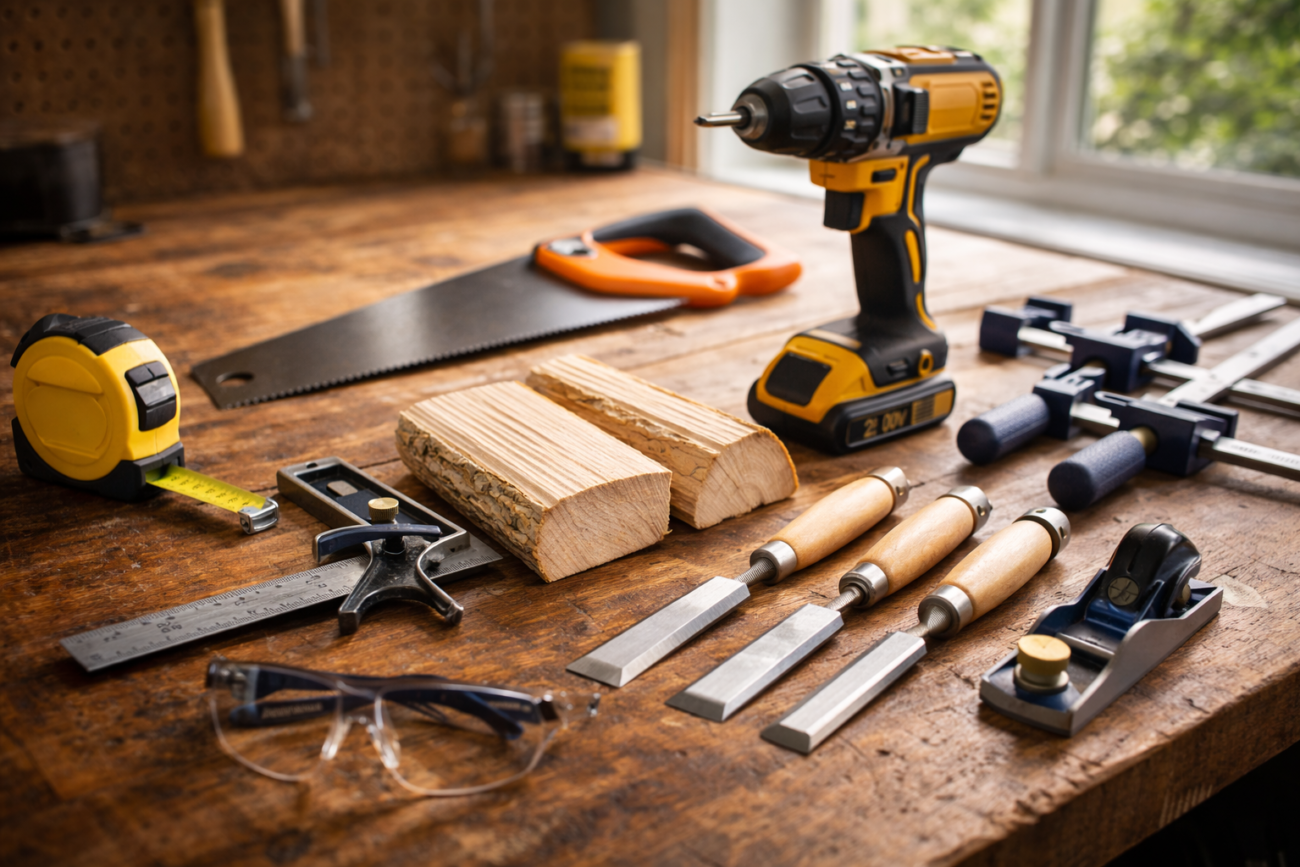
The essential beginner woodworking tools you actually need are: a quality tape measure, combination square, hand saw, circular saw, power drill, chisel set, block plane, random orbital sander, safety glasses, hearing protection, clamps, hammer, screwdriver set, workbench, and a pencil. These 15 items will handle 90% of beginner projects without breaking the bank.
Most beginners make the same mistake, they either buy everything at once (hello, credit card debt) or grab the cheapest tools that break after three uses. Neither approach works. What you need is a strategic list of beginner woodworking tools that balance quality, affordability, and actual usefulness. That’s exactly what this guide delivers, with specific recommendations and honest advice about what matters and what doesn’t when you’re just starting out.
Why These 15 Beginner Woodworking Tools Matter
Here’s the reality: professional woodworkers didn’t start with $10,000 workshops. They built their tool collections strategically, one project at a time. The beginner woodworking tools on this list represent the foundation that every serious woodworker builds upon.
According to the U.S. Bureau of Labor Statistics, there are over 280,000 professional woodworkers in America, and nearly all of them started with basic hand tools before investing in specialty equipment. The tools I’m recommending aren’t just for hobbyists they’re the same foundational beginner woodworking tools that professionals use daily.
What makes these tools essential? They’re versatile enough to handle multiple tasks, durable enough to last years with proper care, and affordable enough that you won’t need a second mortgage. More importantly, learning to use these beginner woodworking tools properly will teach you fundamental skills that transfer to any woodworking project, from simple cutting boards to complex furniture.
The total investment for all 15 beginner woodworking tools ranges from $400 to $800, depending on brand choices. That might sound like a lot, but compare it to buying individual tools as you need them (which costs more) or buying cheap tools twice (which costs even more). This list is designed to be your one-time foundation purchase.
Measuring and Marking Tools
1. Tape Measure (25-foot)

You’ll use your tape measure more than any other tool in your workshop. Every cut, every joint, every dimension starts with accurate measurement. For beginner woodworking tools, a 25-foot tape with a 1-inch wide blade gives you the reach and rigidity you need.
Look for a tape measure with both imperial and metric markings. The blade should have a sturdy hook that stays put and a reliable locking mechanism. I’ve seen beginners struggle with cheap tape measures that won’t lock properly or have hooks that slide around, leading to measurement errors that compound throughout a project.
The difference between a $8 tape and a $25 tape is significant. Better tapes have clearer markings, more durable cases, and blades that don’t kink. Stanley and Milwaukee make excellent options that belong in any collection of beginner woodworking tools. Price range: $15-$30.
2. Combination Square (12-inch)

A combination square does way more than check if your cuts are square. You’ll use it to mark straight lines, measure depths, check 45-degree angles, and verify that surfaces are flat. It’s one of those beginner woodworking tools that seems simple but becomes indispensable.
The key feature is the sliding head that locks at any position along the ruler. This lets you set consistent measurements for repetitive marking. Cheaper combination squares have heads that don’t lock securely or rulers that aren’t actually straight both will mess up your work.
According to Fine Woodworking magazine, a quality combination square should have a hardened steel blade with clear, etched markings. The head should be machined flat and square. Starrett makes the gold standard, but Empire and Swanson offer solid options for beginner woodworking tools budgets. Price range: $25-$75.
3. Quality Pencils and Marking Knife

Don’t laugh, the right marking tools matter more than you’d think. Standard #2 pencils are too thick for precise woodworking. You need carpenter’s pencils or mechanical pencils specifically designed for wood. Better yet, invest in a marking knife for the most accurate lines.
Why does this matter? Wood grain can deflect a saw blade slightly. If your pencil line is 1/16-inch thick and you cut on the wrong side of it, you’re already off by that much. Multiply that across four sides of a box and nothing fits. Sharp, thin marking tools are essential beginner woodworking tools for accuracy.
Marking knives create a precise line and actually sever wood fibers, which helps guide your saw blade. They’re standard in Japanese woodworking and increasingly popular among American craftspeople. Many beginners don’t realize these are critical beginner woodworking tools until they’ve ruined a few boards with imprecise cuts. Price range: $5-$20.
Cutting Tools
4. Hand Saw (Crosscut)

Even if you buy every power tool on this list, you still need a good hand saw. Batteries die, power goes out, and sometimes you need to make a quiet cut without disturbing the neighbors. A quality crosscut hand saw is one of those beginner woodworking tools that connects you to centuries of craftsmanship.
Modern hand saws have vastly improved from what your grandfather used. Today’s saws feature impulse-hardened teeth that stay sharp longer and cut faster with less effort. The key is choosing the right tooth count 10 to 12 teeth per inch works well for general crosscutting in beginner woodworking tools collections.
Japanese pull saws have become incredibly popular because they’re easier to control and make cleaner cuts than traditional Western push saws. The pull stroke keeps the blade in tension, preventing bending and wandering. Popular Woodworking regularly recommends Japanese saws for beginners because they’re more forgiving. Price range: $20-$50.
5. Circular Saw (7.25-inch)

This is your workhorse power tool. A circular saw can rip boards, make crosscuts, cut plywood, and even do basic joinery with the right jigs. For beginner woodworking tools budgets, a circular saw delivers more versatility per dollar than almost any other power tool.
The 7.25-inch blade size is standard and gives you enough cutting depth for most projects while keeping the saw manageable. Look for at least 15 amps of power and a depth adjustment that locks securely. Corded models are cheaper and more powerful than cordless for the same price point.
Blade quality matters enormously. The blade that comes with budget saws is usually garbage. Plan to buy a quality 40-tooth or 60-tooth carbide blade separately. According to The Family Handyman, a good blade on a mediocre saw outperforms a cheap blade on an expensive saw. That’s crucial knowledge for beginner woodworking tools purchases. Price range: $60-$150 for saw, $30-$50 for quality blade.
6. Basic Chisel Set (4-piece)

Chisels are where woodworking transforms from rough cutting to precise craftsmanship. You’ll use them for cleaning up joints, cutting mortises, paring wood to exact dimensions, and countless detail work. A basic 4-piece set (1/4-inch, 1/2-inch, 3/4-inch, 1-inch) covers most beginner woodworking tools needs.
The difference between cheap and quality chisels is night and day. Cheap chisels won’t hold an edge, have soft steel that mushrooms when struck, and often aren’t ground flat on the back. Quality beginner woodworking tools in this category should have hardened steel that takes a sharp edge and keeps it.
You don’t need to buy premium Japanese chisels starting out. Brands like Narex, Stanley Sweetheart, and Irwin Marples offer excellent quality at beginner-friendly prices. Wood Magazine tested dozens of sets and found that mid-range chisels often perform nearly as well as premium options for beginner woodworking tools users. Price range: $40-$100.
Shaping and Smoothing Tools
7. Block Plane (Low-Angle)
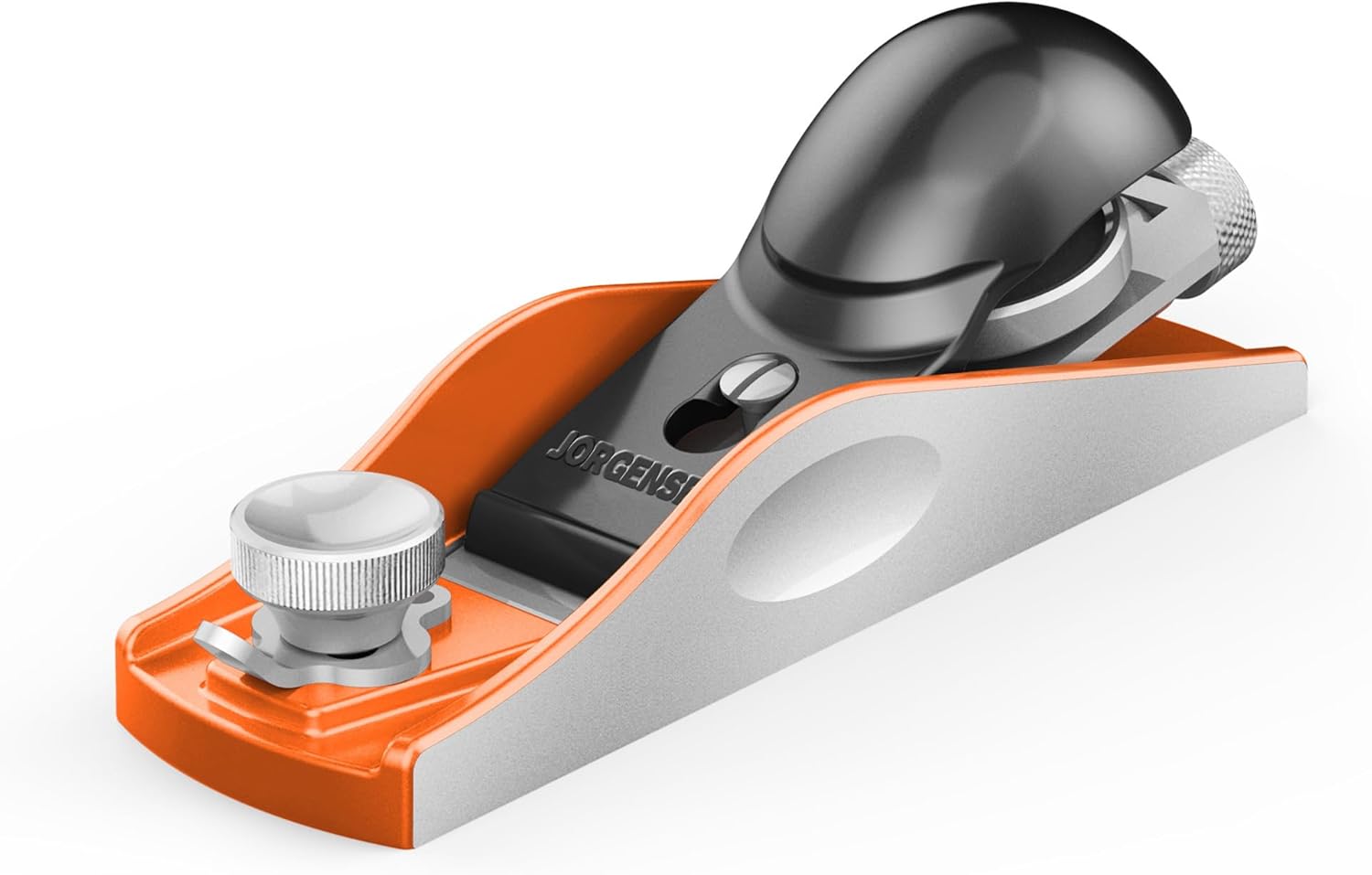
A block plane fits in one hand and handles countless small tasks that make the difference between amateur and professional-looking work. You’ll use it to chamfer sharp edges, trim end grain, fit joints, remove saw marks, and smooth small surfaces. It’s an absolutely essential member of any beginner woodworking tools collection.
Low-angle block planes (12 degrees) work better for end grain than standard-angle planes. The blade is mounted bevel-up, which makes it easier to adjust and sharpen. For beginner woodworking tools, this design is more forgiving and versatile.
Good block planes have adjustable throats (the opening in front of the blade) and lateral adjustment for the blade. Stanley’s No. 60-1/2 is the classic design that countless beginners have learned on. According to research from the Forest Products Laboratory, properly planed wood shows better finish adhesion than sanded wood, making this one of the most valuable beginner woodworking tools for finish quality. Price range: $40-$120.
8. Random Orbital Sander (5-inch)

Sanding by hand is miserable, slow, and produces inconsistent results. A random orbital sander is the power tool that will save your arms and your sanity. The random orbit pattern prevents visible scratch patterns and sands much faster than hand sanding while still giving you control.
The 5-inch pad size is perfect for beginner woodworking tools large enough to cover area quickly but small enough for detailed work. Look for variable speed control so you can slow down for delicate work and speed up for material removal. Dust collection is crucial; breathing wood dust is seriously harmful.
Corded sanders are cheaper and lighter than cordless models. You don’t need to spend $200 on a professional-grade sander starting out. Brands like DeWalt, Bosch, and Makita make excellent beginner woodworking tools in the $60-$100 range that will last for years. The key is buying quality sanding discs, cheap discs load up with dust quickly and sand inefficiently. Price range: $50-$120.
Fastening and Assembly Tools
9. Power Drill/Driver (Cordless)

A cordless drill/driver is probably the most versatile tool you’ll own. Beyond drilling holes and driving screws, you’ll use it with accessories for sanding, mixing finishes, and countless other tasks. Modern lithium-ion batteries have made cordless drills powerful and long-lasting enough to be primary beginner woodworking tools.
The key specs are voltage (18V or 20V is standard), battery capacity (2.0Ah minimum), and whether it’s a drill/driver combo or just a driver. For beginner woodworking tools, get a drill/driver that does both functions. The clutch settings prevent overdriving screws, and the two-speed gearbox gives you high torque or high speed as needed.
Major brands (DeWalt, Milwaukee, Makita, Ryobi) all use proprietary battery systems. Your first cordless tool determines your battery platform for future purchases, so choose wisely. Consumer Reports regularly tests cordless drills and finds that mid-range models often perform nearly as well as premium options for beginner woodworking tools applications. Price range: $80-$150.
10. Clamps (Various Sizes)

Here’s a woodworking truth: you can never have enough clamps. You’ll need them to hold pieces during glue-up, secure workpieces while cutting or routing, create jigs, and maintain pressure while fasteners are driven. Clamps are the unsung heroes of beginner woodworking tools collections.
Start with a basic assortment: four 24-inch bar clamps, four 12-inch bar clamps, and at least six spring clamps. Bar clamps (also called F-clamps) provide serious pressure for edge-gluing boards and assembling large projects. Spring clamps are perfect for light-duty holding and quick setup.
Pipe clamps are cheaper per inch than bar clamps if you’re on a tight budget, you buy the clamp heads and add your own black pipe from the hardware store. However, bar clamps are more convenient and don’t risk staining wood with pipe rust. For essential beginner woodworking tools, invest in at least four quality bar clamps. Price range: $80-$150 for starter set.
Impact and Assembly Tools
11. Hammer (16-ounce Claw)

You might think any hammer will do, but the right hammer makes a real difference. A 16-ounce claw hammer is the sweet spot for beginner woodworking tools heavy enough for serious striking but light enough for control and comfort during extended use.
Look for a hammer with a smooth face (not milled) to avoid leaving marks on wood, a comfortable grip, and a balanced feel. The claw should be sharp enough to pull nails effectively. Steel-handle hammers transfer more shock to your arm; fiberglass or wood handles absorb vibration better.
One trick many beginners don’t know: keep your hammer face clean. Wood residue and glue buildup on the striking face can cause the hammer to glance off nail heads. According to This Old House, a quality hammer with proper care will last decades, making it one of the best value beginner woodworking tools you can buy. Price range: $20-$45.
12. Screwdriver Set (Multi-bit)

Even with a power drill, you need manual screwdrivers. They give you precise control for delicate work, access tight spaces where drills don’t fit, and work when batteries are dead. A quality multi-bit screwdriver set is essential among beginner woodworking tools.
Get a set with at least Phillips (#1, #2, #3) and slotted (1/4-inch, 3/16-inch, 5/16-inch) bits. Many sets include square drive and Torx bits, which are increasingly common in modern screws and hardware. The handles should be comfortable and provide good grip.
Magnetic tips are incredibly helpful, they hold screws in place during starting. Some screwdrivers have ratcheting mechanisms that speed up work. Klein Tools and Craftsman make excellent beginner woodworking tools sets that balance quality and price. Don’t buy the absolute cheapest set; soft metal bits will strip out quickly. Price range: $25-$60.
Safety Equipment
13. Safety Glasses (ANSI Z87.1 Rated)

This is non-negotiable. Every woodworker knows someone with a shop injury story, and eyes are especially vulnerable. Wood chips, sawdust, and metal particles from tools can cause permanent damage. Safety glasses are the most important beginner woodworking tools for protecting yourself.
ANSI Z87.1 is the safety rating standard in the United States. According to the Centers for Disease Control and Prevention (CDC), proper eye protection prevents 90% of serious eye injuries in woodworking. Look for wraparound designs that protect from side impacts and glasses that fit comfortably enough that you’ll actually wear them.
Anti-fog coating is worth the extra few dollars if you work in varying temperatures. Some safety glasses fit over prescription eyewear. And yes, you need to wear them even for “quick” tasks that’s when most injuries happen. These beginner woodworking tools literally preserve your sight. Price range: $10-$30.
14. Hearing Protection (NRR 25+ Rating)

Power tools are loud enough to cause permanent hearing damage. A circular saw runs around 100 decibels, and prolonged exposure causes irreversible hearing loss. The Occupational Safety and Health Administration (OSHA) states that exposure to 100 decibels for more than 15 minutes per day causes hearing damage.
Noise Reduction Rating (NRR) measures how much sound protection blocks. Look for at least NRR 25 for beginner woodworking tools. You have two main options: foam earplugs (cheap, effective, but disposable) and earmuffs (reusable, more comfortable for extended use, easier to put on and remove frequently).
Many woodworkers prefer electronic earmuffs that block loud noises but allow normal conversation. You can hear safety warnings and instructions while still protecting your ears from tool noise. This is especially valuable when working with others or learning beginner woodworking tools techniques from experienced woodworkers. Price range: $8-$60.
Workspace Essentials
15. Workbench or Portable Work Table

You can’t do quality woodworking on your dining room table. You need a solid, flat surface that can handle clamping pressure, resist damage from hammering and cutting, and provide a stable platform for assembly. A workbench is the foundation of your beginner woodworking tools setup.
Full-size workbenches are ideal but expensive and space-intensive. For beginners, a portable work table like the Black+Decker Workmate or similar folding bench offers 90% of the functionality at a fraction of the cost and space. These portable benches include integrated clamps and fold flat for storage.
What matters most is stability and flatness. Your bench should not rock or wobble during use. The work surface should be reasonably flat (within 1/16-inch across its length). According to Woodcraft, the workbench you’ll actually use is better than the perfect bench you’ll build “someday.” Start with something functional among your beginner woodworking tools and upgrade later. Price range: $75-$200 for portable bench, $300-$600 for permanent bench.
Building Your Beginner Woodworking Tools Collection Strategically
Don’t buy everything at once unless you have the budget and storage space. Here’s a smarter approach: start with the absolute essentials, then add tools as specific projects require them. This strategy prevents buyer’s remorse and ensures you’re investing in beginner woodworking tools you’ll actually use.
Phase 1 – Essential Starter Set ($250-$400):
- Tape measure and combination square
- Hand saw
- Hammer and screwdriver set
- Safety glasses and hearing protection
- Basic clamps (4 bar clamps, 6 spring clamps)
- Portable workbench
This minimal set of beginner woodworking tools lets you build simple projects like cutting boards, small boxes, picture frames, and basic shelving. You’ll develop fundamental skills without a huge investment.
Phase 2 – Power Tool Additions ($300-$450):
- Circular saw with quality blade
- Cordless drill/driver
- Random orbital sander
- Additional clamps as needed
Adding these beginner woodworking tools expands your project capabilities significantly. You can now handle larger projects, work faster, and achieve better surface finishes.
Phase 3 – Precision Tools ($100-$150):
- Chisel set
- Block plane
- Marking knife
- Additional measuring tools
These beginner woodworking tools elevate your work from functional to fine. Joints fit better, surfaces are smoother, and your projects look more professional.
Common Beginner Woodworking Tools Mistakes to Avoid
- Buying Cheap Tools Twice: The cheapest tools are tempting when you’re starting out, but they often fail quickly or perform so poorly that you replace them anyway. You end up spending more money and dealing with frustration. Better to buy fewer, quality beginner woodworking tools than a garage full of junk.
- Ignoring Safety Equipment: Safety glasses and hearing protection seem optional until you need them. According to the Consumer Product Safety Commission (CPSC), power tools cause over 400,000 emergency room visits annually, many from preventable eye injuries. Make safety gear your first beginner woodworking tools purchase, not an afterthought.
- Buying Tools for Imaginary Projects: That dado blade set seems essential until you realize you’ve never actually needed one. Buy beginner woodworking tools for projects you’re building now, not projects you might build someday. Your garage isn’t a tool museum.
- Neglecting Tool Maintenance: Sharp blades cut better and safer than dull ones. Clean tools last longer than dirty ones. Proper storage prevents rust and damage. Include maintenance supplies (sharpening stones, lubricants, cleaning brushes) in your beginner woodworking tools budget and actually use them.
- Comparing Yourself to Professionals: Professional woodworkers have thousands of dollars in specialized tools accumulated over decades. You don’t need a $3,000 table saw to make beautiful furniture. Master your beginner woodworking tools first, then upgrade as your skills and projects demand.
Where to Buy Beginner Woodworking Tools
- Big Box Stores (Home Depot, Lowe’s) Convenient, good return policies, frequent sales. Best for basic beginner woodworking tools and power tools. Selection leans toward contractor-grade rather than fine woodworking tools.
- Specialty Woodworking Stores (Rockler, Woodcraft) Expert staff, higher quality hand tools, specialty items. Prices run higher but you get knowledgeable advice. Great for beginner woodworking tools when you need guidance on quality differences.
- Online Retailers (Amazon, Acme Tools) Huge selection, competitive pricing, convenient delivery. Read reviews carefully and check return policies. Good for beginner woodworking tools when you know exactly what you want.
- Used Tool Sources (Estate Sales, Craigslist, Facebook Marketplace) Vintage tools often have better quality than modern budget options. Hand tools especially can be excellent values. Requires knowledge to spot quality, but you can build a collection of beginner woodworking tools for half the retail cost.
According to Consumer Reports, buying previous-generation models when new versions launch can save 30-50% on power tools with minimal feature differences. This is smart shopping for beginner woodworking tools budgets.
Maintaining Your Beginner Woodworking Tools
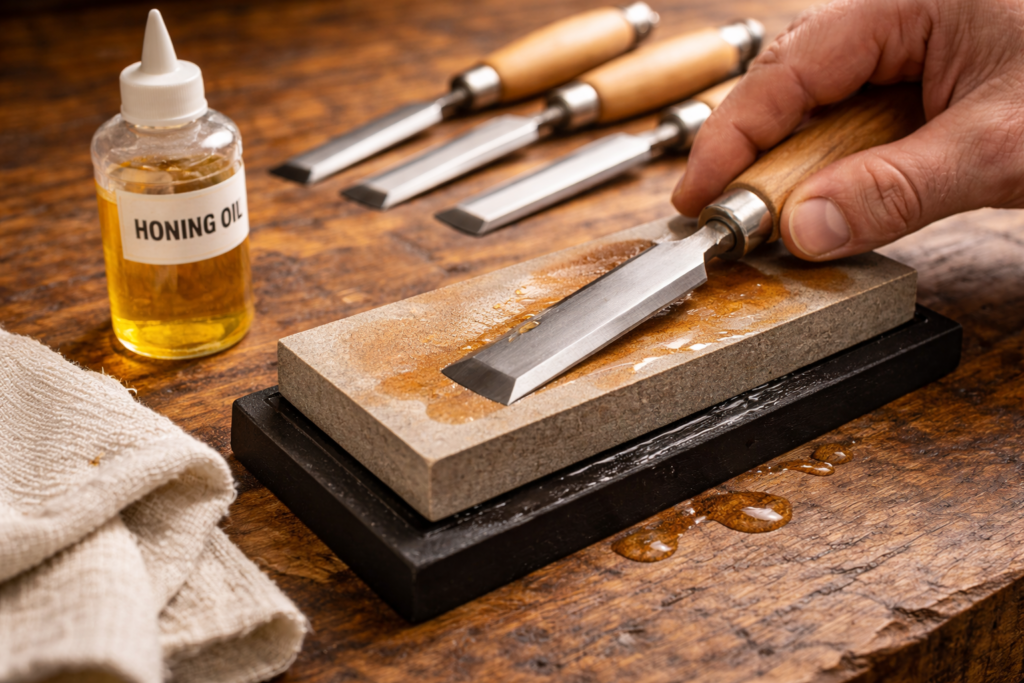
Tools last decades with proper care and weeks with neglect. Here’s what actually matters for beginner woodworking tools maintenance:
Daily Maintenance
- Brush sawdust off tools before storing
- Wipe down metal surfaces to prevent rust
- Check power cords for damage
- Empty dust collection bags
Weekly Maintenance
- Sharpen chisels and plane blades as needed
- Clean saw blades with pitch remover
- Check that square tools are actually square
- Lubricate moving parts on clamps and tools
Monthly Maintenance
- Inspect power tool brushes and bearings
- Deep clean shop and tool storage
- Organize and inventory beginner woodworking tools
- Replace worn safety equipment
Seasonal Maintenance
- Apply paste wax to metal surfaces for rust prevention
- Check and tighten any loose handles or knobs
- Replace old or damaged blades and bits
- Service power tools per manufacturer recommendations
The National Wood Flooring Association recommends keeping tools in climate-controlled storage when possible. Extreme temperature and humidity changes cause metal to rust and wood handles to crack, shortening the life of your beginner woodworking tools.
First Projects for Your New Beginner Woodworking Tools
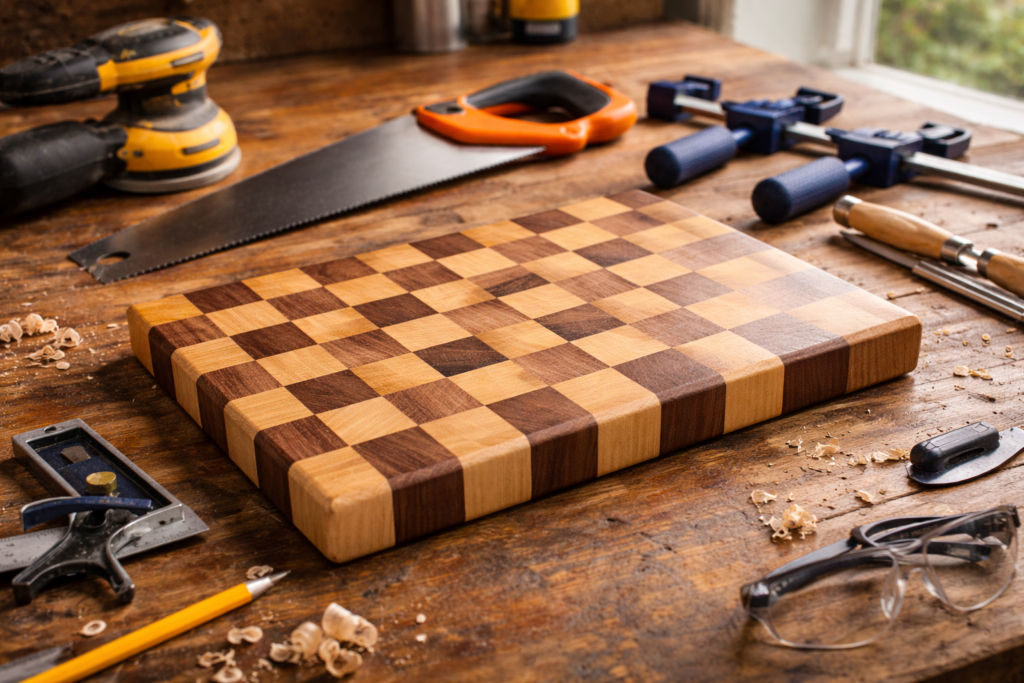
Once you’ve assembled your beginner woodworking tools collection, start with projects that teach fundamental skills without overwhelming complexity:
- Cutting Board Uses: measuring, crosscutting, edge gluing, sanding, finishing. This classic first project teaches you to mill lumber square, glue boards flat, and create food-safe finishes. Total cost: $15-$30 in materials.
- Simple Box Uses: measuring, cutting to length, basic joinery, assembly, clamping. Building a box teaches you about square corners, grain direction, and how wood moves. These skills transfer to countless future projects.
- Picture Frame Uses: accurate measuring, 45-degree miters, careful gluing, finishing. Frames demand precision gaps and misalignments are immediately visible. Perfect for learning accuracy with your beginner woodworking tools.
- Small Shelf or Bookcase Uses: larger cuts, drilling pocket holes or dowels, assembly, leveling. This project scales up your skills and introduces basic furniture construction techniques.
Start simple and build skills progressively. According to Popular Mechanics, most woodworking failures come from attempting projects beyond current skill level, not from lack of tools. Master your beginner woodworking tools with basic projects before tackling complex furniture.
FAQs About Beginner Woodworking Tools
What are the most essential beginner woodworking tools to start with?
The absolute essentials are a tape measure, combination square, hand saw, cordless drill, basic clamps, hammer, safety glasses, and a work surface. These eight beginner woodworking tools will handle most simple projects and teach fundamental skills. You can add circular saw, sander, and chisels as your second wave of purchases.
How much should I budget for beginner woodworking tools?
Plan to spend $400-$800 for a complete starter collection of beginner woodworking tools that will last years. You can start with the bare essentials for $250-$300 and add tools as projects require them. Avoid buying the cheapest options, as they often need replacement quickly, but you don’t need premium professional-grade tools when starting out either.
Should I buy cordless or corded power tools as a beginner?
For drills, cordless is worth the extra cost for convenience. For stationary tools like circular saws and sanders, corded models offer more power at lower prices, making them better beginner woodworking tools choices. The exception is if you already own a battery platform from other tools then staying within that system makes sense.
Are cheap beginner woodworking tools worth buying to see if I like woodworking?
This approach usually backfires because cheap tools perform so poorly that they make woodworking frustrating rather than enjoyable. Instead, buy a smaller selection of quality beginner woodworking tools, or borrow tools from friends or local tool libraries. Poor tools teach bad habits and make you think you lack skill when really the tool is the problem.
What’s the difference between contractor-grade and hobbyist beginner woodworking tools?
Contractor tools prioritize durability and speed for job sites, often sacrificing precision and fine adjustment. Hobbyist beginner woodworking tools emphasize accuracy and versatility for shop use. For most beginners, hobbyist-grade tools from quality brands offer the best balance of performance and price. You don’t need contractor-grade durability unless you’re actually contracting.
How do I know when it’s time to upgrade from beginner woodworking tools?
Upgrade when your current tools limit the quality or types of projects you want to build, not just because you want fancier equipment. If you’re consistently fighting your tools to achieve results, if you’ve mastered the basics and need more precision, or if a specific project genuinely requires a specialized tool, then it’s time to upgrade from beginner woodworking tools.
Can I learn woodworking with just hand tools, or do I need power tools?
You can absolutely learn with hand tools only traditional woodworking was entirely hand tools for centuries. Hand-tool woodworking teaches excellent technique and requires less investment in beginner woodworking tools. However, power tools speed up repetitive tasks significantly. Most beginners find that a mix of hand and power tools offers the best learning experience and project variety.
Conclusion: Start Building With Confidence
You don’t need a truck full of equipment to start woodworking. These 15 beginner woodworking tools represent everything necessary to build hundreds of different projects, from simple boxes to basic furniture. More importantly, they teach you the fundamental skills that every woodworker needs regardless of experience level.
The key is starting with quality beginner woodworking tools that you’ll actually use rather than accumulating a garage full of specialty equipment for imaginary projects. Buy strategically, maintain your tools properly, and focus on building skills with what you have. Every professional woodworker started exactly where you are now, with basic beginner woodworking tools and the willingness to learn.
Your first projects won’t be perfect, and that’s completely normal. What matters is that you’re building something real, learning valuable skills, and developing a craft that can last a lifetime. The beginner woodworking tools in this guide will serve you well for years if you treat them right and keep practicing.
Start with your first project this weekend. Pick something simple, gather your beginner woodworking tools, and make something useful. You’ll be amazed at what you can accomplish with just these essentials and a bit of determination. And if you’re looking for more hands-on guides and tool recommendations, check out WoodStoveHub for practical advice on working with wood and creating a self-sufficient workshop.
