
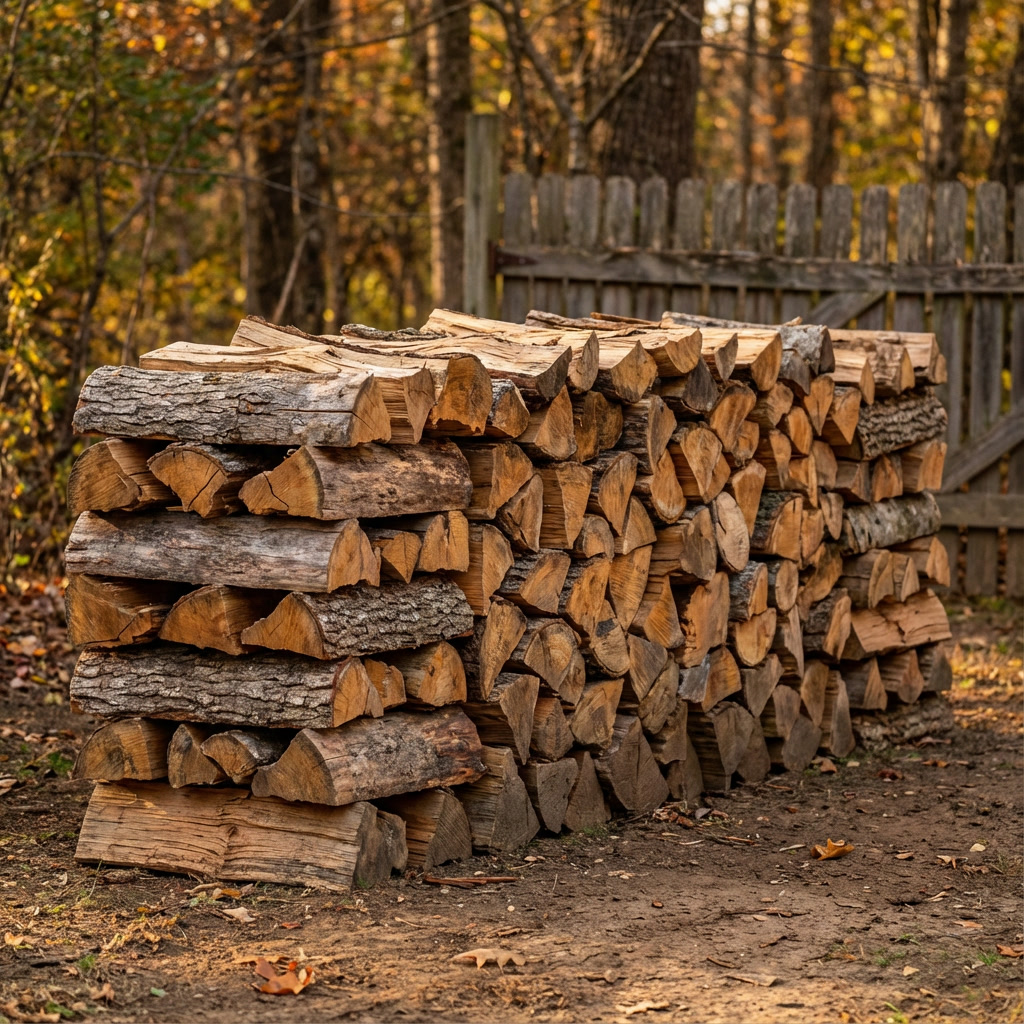
How much does a cord of wood weigh? If you’re buying firewood for the first time, this question isn’t just curiosity, it’s practical knowledge you need. Understanding how much does a cord of wood weigh helps you know if your truck can handle the load, whether that delivery price makes sense, and if you’re actually getting what you paid for.
Here’s the answer: A full cord of seasoned firewood typically weighs between 2,500 and 3,500 pounds, depending on the wood species. Green (freshly cut) wood weighs significantly more, ranging from 4,000 to 5,500 pounds per cord because it’s loaded with moisture. That’s nearly double the weight, and when you’re asking how much does a cord of wood weigh, understanding this difference matters enormously.
The weight variation isn’t random. Different tree species have different densities, moisture content changes everything, and even how the wood is stacked affects the actual amount you’re getting. If you’ve ever bought a “face cord” thinking it was a full cord, you know exactly what I’m talking about. Knowing how much does a cord of wood weigh helps you avoid getting shortchanged and ensures you’re prepared for the physical reality of managing your firewood supply.
In this guide, we’ll break down everything about how much does a cord of wood weigh: what affects it, how different species compare, why moisture content matters so much, and how to verify you’re getting an honest cord. Whether you’re buying your first wood stove or you’re a seasoned burner looking to optimize your fuel costs, understanding how much does a cord of wood weigh will help you make smarter decisions.
How Much Does a Cord of Wood Weigh: Understanding the Basics

Before we can accurately answer how much does a cord of wood weigh, we need to clear up what a cord actually is. There’s a lot of confusion out there, and sellers sometimes take advantage of that when you’re trying to figure out how much does a cord of wood weigh.
A full cord is a precisely defined measurement: 128 cubic feet of stacked wood. That breaks down to a stack that’s 4 feet high, 4 feet deep, and 8 feet long. It’s a legal standard in most states, which means sellers are required to deliver this amount when they advertise a “cord.”
The problem is, not everyone sells full cords. You’ll hear terms like “face cord,” “rick,” or “truck load,” and these are intentionally vague. A face cord is typically one-third of a full cord, it’s 4 feet high and 8 feet long but only 16 inches deep (one row of wood cut to standard stove length). When considering how much does a cord of wood weigh, these partial measurements create confusion.
Why Understanding How Much Does a Cord of Wood Weigh Matters
Firewood sellers know most buyers don’t measure. They’ll stack wood loosely, use smaller pieces, or simply deliver less than promised. According to the U.S. Forest Service, consumers lose millions annually to firewood fraud, mostly from mismeasurement.
When you’re trying to figure out how much does a cord of wood weigh, you first need to confirm you’re actually dealing with a full cord. Otherwise, your weight calculations will be off, and you won’t know if you’re getting a fair deal.
The Air Space Factor in Wood Weight
Here’s something most people don’t consider when asking how much does a cord of wood weigh: a cord measurement includes air space between the logs. Depending on how tightly the wood is stacked and the size and shape of the pieces, you might have anywhere from 60-85 cubic feet of actual solid wood in a 128 cubic foot cord.
This matters for weight because you’re not weighing 128 cubic feet of solid wood, you’re weighing whatever solid volume is actually in that stack. Well-split, uniform pieces stack tighter and give you more actual wood. Irregularly shaped rounds with lots of gaps give you less. This is one reason why how much does a cord of wood weigh can vary even within the same species.
How Much Does a Cord of Wood Weigh: Green Wood vs Seasoned Wood
The single biggest factor affecting how much does a cord of wood weigh is moisture content. Freshly cut “green” wood contains an enormous amount of water, sometimes making up 50% or more of the wood’s total weight.
When wood is first cut, the cells are saturated with water. A living tree pulls water from its roots to its leaves constantly, and that moisture doesn’t magically disappear when you fell the tree. Green oak, for example, can weigh over 5,000 pounds per cord. That same oak, after proper seasoning, might weigh around 3,750 pounds per cord. Understanding how much does a cord of wood weigh in both states is crucial.
What Seasoning Does to Wood Weight
Seasoning firewood is the process of letting wood dry out naturally over time. You stack it in a well-ventilated area, keep it off the ground, cover the top (but not the sides), and wait. Depending on your climate and the wood species, proper seasoning takes 6 months to 2 years.
As moisture evaporates, the wood becomes lighter, burns hotter, produces less creosote, and generates more usable heat. The U.S. Environmental Protection Agency recommends burning only wood with moisture content below 20% for efficiency and air quality.
Here’s a detailed table showing how much does a cord of wood weigh for common species in both green and seasoned states:
| Wood Species | Green Weight (lbs/cord) | Seasoned Weight (lbs/cord) | Weight Reduction |
|---|---|---|---|
| Oak (White) | 5,573 | 3,920 | 30% |
| Oak (Red) | 5,120 | 3,680 | 28% |
| Maple (Hard) | 4,685 | 3,200 | 32% |
| Ash | 4,184 | 2,880 | 31% |
| Hickory | 5,120 | 3,840 | 25% |
| Birch (Yellow) | 4,312 | 2,992 | 31% |
| Cherry | 3,696 | 2,560 | 31% |
| Pine (White) | 3,312 | 2,250 | 32% |
| Poplar | 3,904 | 2,080 | 47% |
| Cedar | 2,944 | 1,950 | 34% |


You can see the pattern clearly when examining how much does a cord of wood weigh: green wood weighs significantly more. If someone delivers “seasoned” wood that feels impossibly heavy, there’s a good chance it’s not actually seasoned, no matter what they told you.
Why You Should Never Burn Green Wood
Beyond the weight issue when considering how much does a cord of wood weigh, burning green wood is a terrible idea. It produces less heat (because energy goes into evaporating water instead of warming your home), creates excessive smoke, and deposits dangerous creosote in your chimney. That creosote buildup is a leading cause of chimney fires.
Understanding how much does a cord of wood weigh when green versus seasoned helps you identify whether you’re actually getting dry wood. If you can, invest in a moisture meter to check. They’re inexpensive and can save you from wasting money on wet wood that won’t burn properly.
How Much Does a Cord of Wood Weigh by Species
Not all firewood is created equal when determining how much does a cord of wood weigh. The species of tree makes a massive difference in how much does a cord of wood weigh, even when comparing wood at the same moisture content. This comes down to wood density, the amount of actual woody material packed into each cubic foot.
Dense hardwoods like oak, hickory, and maple have tightly packed cells and weigh considerably more than softwoods like pine or cedar. But here’s what matters: denser woods also contain more potential energy per cubic foot, which means they burn longer and produce more heat.
Hardwoods vs Softwoods Weight Comparison
When people talk about “hardwood” and “softwood,” they’re referring to the tree type, not necessarily the wood’s actual hardness. Hardwoods come from deciduous trees (ones that lose their leaves), while softwoods come from conifers (evergreens with needles).
Generally speaking, hardwoods are denser and heavier, which directly affects how much does a cord of wood weigh. A cord of seasoned oak weighs around 3,700-3,900 pounds, while a cord of seasoned pine might only weigh 2,200-2,500 pounds. That weight difference translates directly to heat output. Oak delivers roughly 24-28 million BTUs per cord, while pine provides about 15-17 million BTUs.
Does this mean you should never burn softwoods? Not at all. Pine and other softwoods ignite easily, making them excellent for starting fires or shoulder season burning when you don’t need intense heat. They’re also typically cheaper. But if you’re heating your home through a hard winter, hardwoods are the way to go, and knowing how much does a cord of wood weigh helps you plan accordingly.
Regional Availability and Wood Weight
How much does a cord of wood weigh also depends on what’s available in your area. In the Pacific Northwest, you might burn Douglas fir or cedar. In the Northeast, oak and maple dominate. In the South, hickory and oak are common, while the Midwest sees a lot of ash and maple.
The best firewood is often whatever’s locally abundant and properly seasoned. Shipping dense hardwoods long distances doesn’t make economic sense, so work with what grows near you. Your local firewood suppliers will typically offer species native to your region, and understanding how much does a cord of wood weigh for each species helps you budget and prepare.
How Much Does a Cord of Wood Weigh: Calculating for Practical Use
Knowing the exact weight range of how much does a cord of wood weigh helps, but you also need practical ways to estimate how much does a cord of wood weigh when you’re actually buying or moving firewood. Here are methods that work in real-world situations.
The Truck Bed Test for Wood Weight
Most full-size pickup trucks can safely carry 1,500-2,000 pounds in the bed, depending on the model. That’s roughly half a cord of seasoned hardwood or a bit more of seasoned softwood. If a seller claims they can deliver a full cord in a single pickup load, they’re either lying about the amount or risking serious vehicle damage based on how much does a cord of wood weigh.
A full cord of seasoned oak (around 3,800 pounds based on how much does a cord of wood weigh) would require two trips in a half-ton truck, or one trip in a larger truck with a higher payload capacity. Green wood? You’re looking at even more weight, potentially requiring three trips or a heavy-duty truck.
When someone offers firewood delivery, ask what vehicle they use. If they’re showing up with a small pickup and claiming it’s a full cord, you’re about to get shorted, and understanding how much does a cord of wood weigh protects you.
Weight Per Piece Estimation
If you want to get technical about how much does a cord of wood weigh, you can estimate by weighing individual pieces. A well-seasoned oak split that’s 16 inches long and roughly 4-6 inches in diameter typically weighs 8-12 pounds. Count how many pieces you can fit in a cord-sized space (roughly 600-700 pieces for average splits), and multiply.
This isn’t practical for every purchase, but it’s useful if you’re suspicious about a delivery and want to verify how much does a cord of wood weigh. Weigh a random sample of 10-15 pieces, calculate the average, and multiply by your count. It won’t be perfect, but it’ll tell you if you’re in the right ballpark.
The Stack and Calculate Method
Stack the delivered wood properly (tight and uniform), then measure the dimensions. Multiply height × width × length to get cubic feet. A full cord should measure 128 cubic feet when stacked.
If the dimensions are off, you can estimate how much does a cord of wood weigh based on what you actually received. For example, if you measure 96 cubic feet of stacked oak, that’s 75% of a cord. Multiply the expected full cord weight by 0.75 to estimate how much does a cord of wood weigh in your actual delivery.
Moisture Content and Weight Verification
Here’s a trick seasoned wood burners use to verify how much does a cord of wood weigh: check the weight and the moisture content together. If someone delivers what they claim is seasoned oak (should weigh around 3,800 lbs/cord based on how much does a cord of wood weigh), but it feels closer to 5,000+ pounds and your moisture meter reads 30-40%, that wood isn’t seasoned.
According to research from Virginia Tech, properly seasoned firewood should measure below 20% moisture content. Anything above 25% is still too wet for efficient burning, regardless of how long the seller claims it’s been sitting. This directly affects how much does a cord of wood weigh.
Common Firewood Scams Related to Weight

Unfortunately, firewood fraud is common, and understanding how much does a cord of wood weigh is part of protecting yourself. Unscrupulous sellers know most buyers don’t verify measurements, and they take advantage. Here are common tricks related to how much does a cord of wood weigh.
The “Face Cord” Bait and Switch
This is the most prevalent scam affecting how much does a cord of wood weigh calculations. A seller advertises a “cord” at a seemingly great price, delivers a face cord (one-third of a full cord), and claims that’s what you ordered. When you complain, they say you should have specified a “full cord.”
Always clarify before purchasing. Ask explicitly: “Is this a full cord, 128 cubic feet, 4×4×8 feet? How much does a cord of wood weigh for the species you’re selling?” Get it in writing if possible. If someone uses terms like “face cord,” “rick,” or “stove cord” without specifying dimensions, ask for exact measurements to properly calculate how much does a cord of wood weigh.
Loose Stacking to Hide Shortages
Some sellers deliberately stack wood loosely with large gaps between pieces. This makes a smaller amount of wood take up more visual space, fooling buyers who judge by appearance rather than understanding how much does a cord of wood weigh.
When wood is delivered, restack it yourself (or have the seller stack it while you watch) to verify the actual volume and confirm how much does a cord of wood weigh. The National Institute of Standards and Technology provides official guidelines for firewood measurement that require wood to be “ranked and well stowed” for accurate volume assessment.
Mixing Green and Seasoned Wood
Here’s a sneaky one that affects how much does a cord of wood weigh: a seller mixes green wood in with seasoned wood, usually putting the seasoned pieces on the outside of the stack where you can see them. The green wood weighs more, burns poorly, and you don’t discover the problem until you start burning through your supply.
This is why a moisture meter is essential for verifying how much does a cord of wood weigh accurately. Test pieces from different parts of the stack, not just the outside. If readings vary wildly, you’ve got mixed wood, and the total weight won’t match what you expect for how much does a cord of wood weigh when properly seasoned.
Short Pieces and Small Splits
Some sellers cut wood shorter than 16 inches or split it into tiny pieces. While this might seem like a favor (easier to handle), it actually means less wood, affecting how much does a cord of wood weigh. Smaller pieces create more air space when stacked, reducing the actual solid wood volume you receive.
Standard firewood is cut to 16 inches because it fits most stoves and stacks efficiently. If pieces are consistently 12-14 inches, you’re getting less wood per cord measurement, even if the stack dimensions look right. This directly impacts how much does a cord of wood weigh in actual delivered product.
How to Verify How Much Does a Cord of Wood Weigh

You’ve learned how much does a cord of wood weigh in theory, but how do you verify what you’re actually receiving? Here are practical steps every firewood buyer should take to confirm how much does a cord of wood weigh in their delivery.
Measure Before You Pay
Don’t accept delivery without measuring to verify how much does a cord of wood weigh. Bring a tape measure and check the stack dimensions yourself. It should be 4 feet high, 4 feet deep, and 8 feet long for a full cord. If the seller stacks it in multiple rows, make sure the total adds up to 128 cubic feet.
If you’re picking up wood yourself, measure it before loading. Sellers who operate honestly won’t mind, they’ll understand you’re being careful about confirming how much does a cord of wood weigh. Sellers who get defensive or refuse to let you measure are probably running a scam.
Check the Weight If Possible
If you have access to a vehicle scale (many recycling centers and farm supply stores have public scales), weigh your empty vehicle, load the firewood, then weigh again. The difference tells you exactly how much does a cord of wood weigh in your specific delivery.
Compare this to expected weights for the species you bought. If you ordered seasoned oak (should be 3,700-3,900 lbs/cord based on how much does a cord of wood weigh), but the weight comes in at 2,500 pounds, you either got a different species, partially seasoned wood, or less than a full cord.
Use a Moisture Meter to Verify Weight Claims
Test multiple pieces from different areas of the stack to verify claims about how much does a cord of wood weigh. Split a few pieces open and test the interior, moisture content can be lower on the surface than inside. According to Oregon State University Extension, wood should be tested in the center of a freshly split face for accurate readings.
Seasoned wood should read below 20%, confirming the weight you expect for how much does a cord of wood weigh when properly dried. Wood at 20-25% is marginal. Anything above 25% needs more drying time before it should be burned, and it will weigh more than expected for seasoned wood.
Get Recommendations and Check Reviews
Word of mouth is powerful in the firewood business when verifying how much does a cord of wood weigh. Ask neighbors, check local Facebook groups, and read online reviews. Honest firewood sellers build reputations over years, scammers usually don’t last long once word gets out about delivering less weight than promised.
When you find a good supplier who consistently delivers accurate weights for how much does a cord of wood weigh, stick with them. Establish a relationship, buy consistently, and you’ll often get better service and honest measurements without having to verify every delivery.
Know Your Local Regulations
Many states have laws requiring firewood to be sold by the cord or fraction thereof, with specific labeling requirements affecting how much does a cord of wood weigh claims. The National Conference on Weights and Measures provides state-by-state guidelines. If a seller violates these regulations about how much does a cord of wood weigh or cord measurements, you can report them to your state’s weights and measures division.


How Much Firewood Do You Need Based on Weight
Understanding how much does a cord of wood weigh is important, but you also need to know how much firewood to buy. There’s no point calculating weights if you end up with too much or too little for your needs, and understanding how much does a cord of wood weigh helps with planning.
The amount you need depends on several factors: how often you burn, how large your space is, how well insulated your home is, your local climate, and whether wood is your primary or supplementary heat source. Knowing how much does a cord of wood weigh helps with storage and handling planning.
Average Consumption Estimates
For a typical home (1,500-2,000 square feet) using wood as the primary heat source through a winter, you’ll probably burn 3-6 cords over a heating season. That’s a wide range because climate matters enormously. Someone in Minnesota heating through a brutal winter will use more than someone in Tennessee with mild winters, and understanding how much does a cord of wood weigh helps plan for delivery logistics.
If wood is supplementary heat (you have a furnace but use the wood stove to reduce costs or for ambiance), you might only burn 1-2 cords per season.
Keep a log during your first season. Note when you restock your indoor wood supply and estimate how much you’re burning per week. After one winter, you’ll have real data to inform your future purchases, including planning for how much does a cord of wood weigh for delivery capacity.
Storage Space Calculations Based on Weight
Here’s something buyers often overlook when considering how much does a cord of wood weigh: where are you going to put all that wood? A full cord takes up 128 cubic feet when stacked, which is roughly a stack 8 feet long and 4 feet high and deep. Three cords require 384 cubic feet, plus you need to allow for air circulation.
You’ll also want covered storage to keep the wood dry. Rain-soaked wood can reabsorb moisture, undoing months of seasoning and increasing how much does a cord of wood weigh. Plan your storage before you buy in bulk. Many people use firewood racks or build simple shelters with a roof but open sides.
Buying Green Wood to Season Yourself
One money-saving strategy related to how much does a cord of wood weigh is buying green wood at a discount, then seasoning it yourself for the following year. Green wood typically costs 30-50% less than seasoned wood. If you have space and time, this is economical.
But remember: green wood weighs more based on how much does a cord of wood weigh, so you’re hauling extra weight. And it needs proper stacking in a well-ventilated area for 6-24 months depending on species and climate. You’ll need to plan ahead, buying next year’s supply this year.
When calculating how much does a cord of wood weigh for a green wood purchase, remember you’re dealing with the higher weight ranges discussed earlier (4,000-5,500 lbs). Make sure your truck and your back can handle it.
Best Practices for Buying and Handling Heavy Firewood
Once you understand how much does a cord of wood weigh and how to verify quantities, follow these best practices to get the most from your firewood purchases while managing the significant weight involved.
Buy Local When Possible
Firewood is heavy and bulky, which makes shipping expensive, and understanding how much does a cord of wood weigh explains why. Local suppliers can offer better prices because they’re not paying to haul wood long distances. You also reduce the risk of introducing invasive pests like emerald ash borer to your area.
Many states actually restrict firewood transport across county or state lines for this reason. The USDA Animal and Plant Health Inspection Service recommends buying wood where you’ll burn it, which also saves on transportation costs related to how much does a cord of wood weigh.
Season and Store Properly to Maintain Weight
If you’re doing your own seasoning, stack wood in a sunny, windy location off the ground. Use pallets or a rack to allow air circulation underneath. Stack in rows with space between them for airflow. Cover only the top to shed rain, leave the sides open so moisture can escape and reduce how much does a cord of wood weigh through proper drying.
Split wood seasons faster than rounds because there’s more surface area for moisture to evaporate, reducing how much does a cord of wood weigh more quickly. If you have the equipment and physical ability, split your wood before stacking.
Handle Smartly to Protect Your Body
Firewood is heavy work, and knowing how much does a cord of wood weigh should remind you of this. A cord of seasoned hardwood weighing 3,500 pounds means moving that weight multiple times: loading, unloading, stacking, carrying to the house, and loading the stove. That’s a lot of lifting.
Use proper technique: lift with your legs, not your back. Carry wood close to your body. Don’t overload yourself. Use a cart or wheelbarrow for longer distances. Take breaks. Understanding how much does a cord of wood weigh helps you respect the physical demands.
Many people underestimate the physical toll of managing several cords of firewood. If you have physical limitations, consider paying extra for stacked delivery or buying smaller quantities more frequently based on how much does a cord of wood weigh.
Time Your Purchases
Firewood prices typically peak in fall and early winter when demand is highest. If you can, buy in late winter or early spring when sellers are clearing inventory. You’ll often get better prices, and you’ll have all spring and summer for the wood to finish seasoning before you need it, reducing how much does a cord of wood weigh through proper drying.
This also gives you time to verify quality and weight. If the wood isn’t as dry as promised based on how much does a cord of wood weigh, you have months for it to finish seasoning. Buy in October, and you’re burning whatever you get, ready or not.
FAQs
How much does a cord of wood weigh when it’s seasoned?
How much does a cord of wood weigh when seasoned? A seasoned cord of wood typically weighs between 2,500 and 3,500 pounds, depending on the species. Dense hardwoods like oak and hickory weigh more (3,600-3,900 lbs per cord), while lighter woods like pine weigh less (2,200-2,500 lbs per cord). Proper seasoning to below 20% moisture content is essential for these accurate weights.
How much does a cord of wood weigh when it’s green versus seasoned?
How much does a cord of wood weigh green versus seasoned? Green firewood weighs 25-50% more than seasoned wood due to high moisture content. A cord of green oak weighs around 5,500 pounds, while the same cord after seasoning weighs approximately 3,800 pounds. This 1,700-pound difference reflects the water weight that evaporates during the drying process, which is why understanding how much does a cord of wood weigh matters for handling and transportation.
Can a pickup truck carry a full cord based on how much does a cord of wood weigh?
Based on how much does a cord of wood weigh, most half-ton pickup trucks cannot safely carry a full cord of seasoned hardwood in one load. A cord weighing 3,500-4,000 pounds exceeds the typical 1,500-2,000 pound payload capacity of standard pickup trucks. You’ll need two trips with a regular pickup or one trip with a larger truck rated for higher payload to handle how much does a cord of wood weigh.
How do I know if I’m getting a full cord based on how much does a cord of wood weigh?
To verify how much does a cord of wood weigh and ensure you’re getting a full cord, measure the stacked wood to verify it totals 128 cubic feet (4 feet high, 4 feet deep, 8 feet long for a standard stack). Use a moisture meter to confirm the wood is properly seasoned below 20% moisture content. Weigh the load if possible and compare it to expected weights: seasoned hardwoods should weigh 2,500-3,900 lbs per cord.
Why does wood species matter for how much does a cord of wood weigh?
Different tree species have different densities, which directly affects how much does a cord of wood weigh and heat output. Dense hardwoods like oak (3,900 lbs/cord seasoned) contain more wood fiber per cubic foot than softwoods like pine (2,300 lbs/cord seasoned), resulting in longer burn times and higher heat production. Understanding how much does a cord of wood weigh by species helps you choose the best firewood for your needs.
How much does a half cord or face cord of wood weigh?
How much does a cord of wood weigh in partial measurements? A half cord (64 cubic feet) weighs approximately 1,250-1,750 pounds when seasoned, depending on species. A face cord, which is typically one-third of a full cord, weighs roughly 850-1,200 pounds for seasoned hardwood. Always verify the actual dimensions you’re receiving when calculating how much does a cord of wood weigh for partial cord purchases.
How long does it take to season firewood and how does it affect how much does a cord of wood weigh?
Firewood typically requires 6-24 months to properly season, significantly affecting how much does a cord of wood weigh. During seasoning, wood loses 25-50% of its weight as moisture evaporates. Oak requires 12-24 months, while softer woods like pine season in 6-12 months. Properly seasoned wood should measure below 20% moisture content, and understanding how much does a cord of wood weigh helps you verify proper drying.
Conclusion: Making Smart Decisions About Firewood Weight
Understanding how much does a cord of wood weigh isn’t just about numbers on a scale, it’s about making informed decisions that save you money, protect your safety, and ensure you get quality firewood that actually heats your home effectively.
The weight differences you’ve learned, from how much does a cord of wood weigh when green versus seasoned, from oak versus pine, and from an honest cord versus a short cord, all affect how much you pay, how well your fire burns, how much creosote builds up in your chimney, and whether you’re prepared for the physical reality of managing your winter fuel supply.
Start with these fundamentals about how much does a cord of wood weigh: know that a full cord is 128 cubic feet, understand that seasoned wood weighs significantly less than green wood (2,500-3,500 lbs versus 4,000-5,500 lbs), recognize that hardwoods are heavier and hotter-burning than softwoods, and always verify measurements before accepting delivery.
